Anterior vs Posterior Hip Replacement Recovery: A Complete Clinical Comparison

The surgical technique that gets you walking fastest doesn't automatically guarantee a superior joint a decade down the road. If you're currently researching anterior vs posterior hip replacement recovery, you've likely encountered strong opinions and conflicting promises from online forums and surgeon websites alike.
Living with chronic groin or deep buttock pain already drains your energy; adding anxiety about muscle trauma and lengthy downtime only heightens that exhaustion. You want your active life back, but you naturally worry about tissue damage, joint dislocation risks, and whether rigid post-surgical physical restrictions will disrupt your daily routine.
In this guide, you'll gain an objective, clinical understanding of muscle disruption, narcotic needs, and clear functional milestones spanning from day one to six months. We break down the clinical realities of both techniques so you have the confidence to choose the right surgical approach and specialist for your unique anatomy.
Table of Contents
Surgical Anatomy: How Anterior and Posterior Approaches Access the Hip
Week-by-Week Recovery Timeline: Direct Anterior vs Posterior Hip Surgery
Post-Operative Precautions and Daily Movement Restrictions Compared
Complication Profiles: Dislocation Risks, Nerve Irritation, and Healing
Making the Right Choice: Surgeon Experience, Anatomy, and Personalized Care
Surgical Anatomy: How Anterior and Posterior Approaches Access the Hip
Every hip arthroplasty aims to replace damaged bone and cartilage, but the path a surgeon takes to reach your joint profoundly shapes early physical healing. Understanding how hip replacement surgical approaches navigate human anatomy reveals why day-to-day rehabilitation feels noticeably different during the initial weeks. When analyzing anterior vs posterior hip replacement recovery, the core anatomical debate centers on soft-tissue preservation versus surgical exposure.
Preserving muscle attachments directly influences your immediate pelvic stability and gait mechanics. When muscles remain anchored to bone, your nervous system maintains proprioception, which is your natural awareness of joint position in space. By contrast, detaching deep musculature requires deliberate post-operative protection while those soft tissues reattach and heal.
The Direct Anterior Plane: True Muscle-Sparing Access
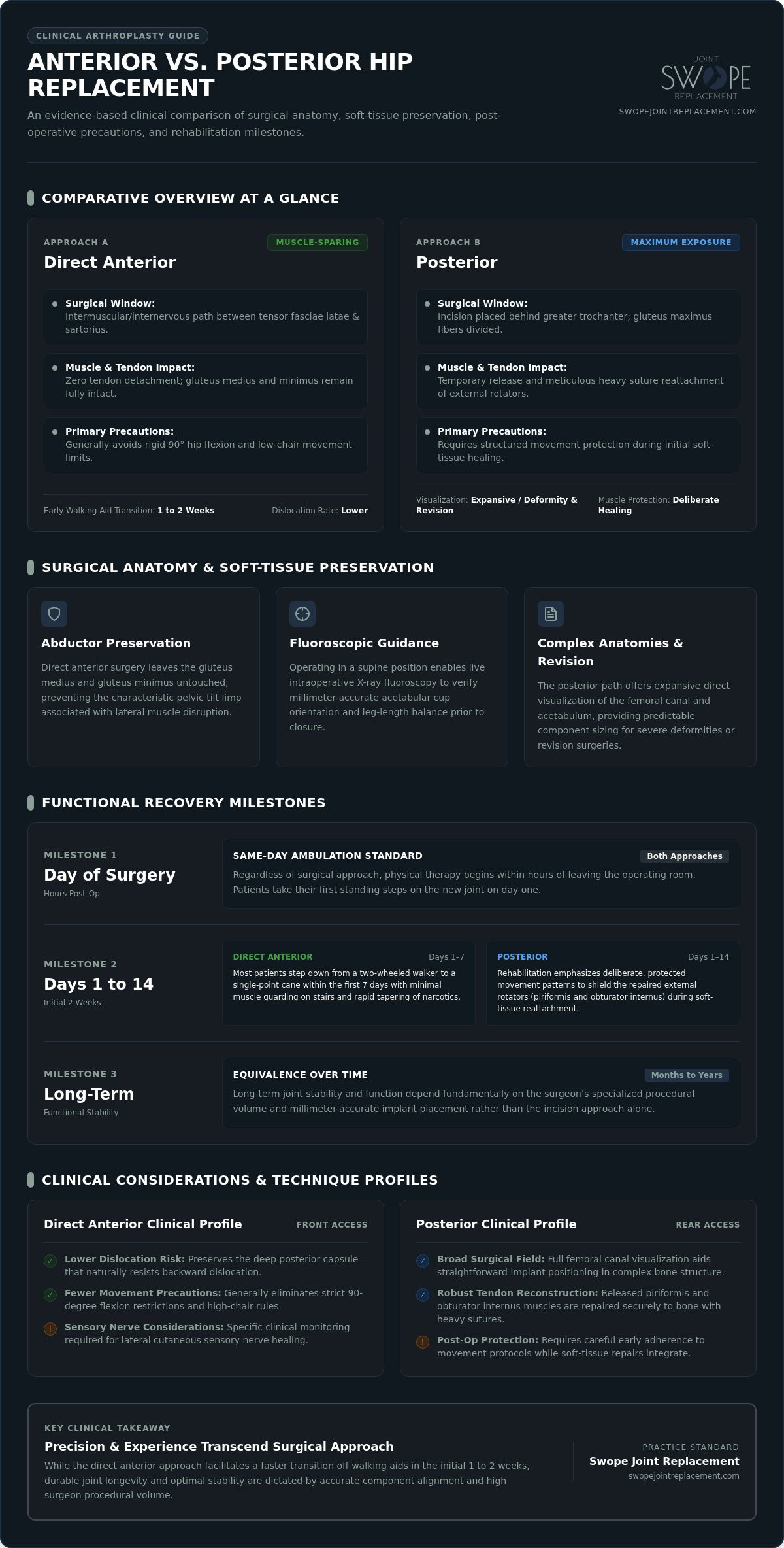
The direct anterior approach uses an incision that starts near the anterior superior iliac spine and extends down the front of your upper thigh. Rather than cutting through structural fibers, your surgeon navigates an intermuscular and internervous window, parting the tensor fasciae latae on the outer side and the sartorius muscle on the inner side.
Working through this natural interval provides distinct functional advantages:
Abductor preservation: The gluteus medius and minimus remain untouched, preventing the characteristic pelvic tilt limp often seen after lateral muscle disruption.
Intact posterior capsule: The deep posterior structures that resist backward dislocation stay completely connected.
Real-time fluoroscopic guidance: Your surgeon operates with you resting flat on your back, allowing live intraoperative X-ray imaging to confirm millimeter-accurate cup orientation and leg-length balance before closing.
The Posterior Approach: Traditional Exposure and Tendon Repair
The posterior approach employs a gently curved incision placed behind your greater trochanter. To access the underlying joint capsule, your surgeon divides the fibers of the gluteus maximus along their natural alignment, then temporarily releases the short external rotator tendons, including the piriformis and obturator internus.
This exposure provides expansive, direct visualization of the femoral canal and acetabulum. Because the femur can be elevated freely, it allows straightforward, predictable component sizing in complex anatomies, severe deformities, or revision procedures. Once the implants are secured, the released tendons are meticulously reattached to the bone using heavy sutures. While modern repairs are strong, this reconstructed tissue demands structural protection during early healing, creating clear differences in anterior vs posterior hip replacement recovery protocols.
Week-by-Week Recovery Timeline: Direct Anterior vs Posterior Hip Surgery
A successful joint replacement transforms your mobility, but how quickly you regain basic independence depends heavily on surgical soft-tissue handling. Clinical insights on anterior vs. posterior hip replacement show that while both paths yield excellent long-term function, the initial recovery trajectory follows distinctly different milestones. Examining anterior vs posterior hip replacement recovery on a week-by-week basis helps you plan home support and set realistic expectations.
Days 1 to 14: Immediate Mobility and Soft Tissue Healing
Same-day ambulation is standard practice regardless of surgical approach. Within hours of leaving the operating room, physical therapists will have you standing and taking your first steps on your new joint.
During these opening two weeks, daily functional milestones diverge quickly:
Direct anterior milestone: Because the abductor and rotator muscles remain undisturbed, patients navigate stairs and household transfers with minimal muscle guarding. Most anterior patients comfortably step down from a two-wheeled walker to a single-point cane within the first seven days. Narcotic requirements taper rapidly during this window.
Posterior milestone: Patients focus on deliberate, protected movements to shield the repaired external rotators. Most rely on a walker for ten to fourteen days before progressing to a cane. In both approaches, keeping the incision clean, dry, and undisturbed remains critical to ensure an uncompromised skin seal.
Weeks 2 to 6: Weaning Assistive Devices and Resuming Independence
Independence accelerates noticeably during this period. Direct anterior patients frequently shed all walking aids between weeks two and four, walking unassisted with a steady, level gait. Posterior patients spend these weeks working through structured physical therapy protocols to gently rebuild strength in their reapproximated rotator tendons, typically setting aside the cane around week four.
Driving clearance generally happens during this window for both cohorts. It requires two distinct criteria: you must be entirely off prescription narcotic pain medications, and your right-foot braking reaction time must return to safe, baseline reflexes. For patients seeking a highly personalized recovery path, partnering with a dedicated practice like Swope Joint Replacement ensures direct physician guidance as you clear these early milestones.
Months 2 to 6: Strength Building and Normalizing Long-Distance Gait
By week twelve, functional recovery curves converge substantially. Any lingering anterior thigh stiffness or posterior deep-gluteal soreness generally dissipates as surrounding musculature adapts to your balanced joint geometry. Between months two and six, low-impact activities like road cycling, lap swimming, and golf become comfortable and routine. Full biological fixation, where native bone integrates permanently into the porous titanium implant surface, completes quietly in the background.
Post-Operative Precautions and Daily Movement Restrictions Compared
Post-operative precautions define how freely you navigate your home during the critical initial healing phase. Daily activities like getting out of bed, putting on shoes, and using the bathroom depend entirely on the mechanical stability created during your operation. When assessing anterior vs posterior hip replacement recovery, movement guidelines reflect the anatomical pathways described earlier: you must avoid stressing the precise tissues that were opened to seat your implant.
Every surgical incision leaves a temporary pathway of reduced tissue tension until biological healing seals the joint capsule. According to a Clinical Comparison of Hip Replacement Approaches, modern capsule reconstruction protocols have reduced historical instability across techniques, yet functional restrictions during early recovery remain fundamentally different.
Traditional Posterior Precautions: Protecting Posterior Capsule Repair
Posterior surgery requires strict adherence to positional limits for approximately six weeks to protect the reattached external rotators and repaired posterior joint capsule. These precautions focus on preventing the femoral head from levering backward out of the socket:
No hip flexion beyond 90 degrees: You cannot bend forward past a right angle, requiring high-rise chairs and raised toilet seats.
No internal rotation or crossing legs: Your operative knee and foot must point straight forward or slightly outward, avoiding pigeon-toed postures.
Assistive dressing tools: Slipping on socks or tying footwear mandates the use of reachers, shoehorns, and sock aids.
Sleeping with an abduction wedge: You must sleep on your back with a firm pillow between your legs to stop unintended leg crossing.
Direct Anterior Freedom: Performing Normal Daily Bends Safely
Direct anterior hip replacement largely eliminates these rigid 90-degree flexion barriers because the posterior muscular wall was never touched. Patients can sit comfortably in standard-height living room chairs, use regular household toilets, and bend forward to tie their shoes without fear of posterior dislocation.
Anterior patients observe a different, far less intrusive set of precautions during the first six weeks. Because the anterior capsule was accessed to seat the prosthesis, you must avoid hyperextending your leg backward while simultaneously turning your foot outward. For instance, stepping far back into an exaggerated lunge or turning your torso sharply away from your planted operative foot places tension on healing anterior tissues. Outside of avoiding that specific hyperextended, externally rotated position, your daily functional movement remains natural, intuitive, and unrestricted, simplifying anterior vs posterior hip replacement recovery at home.
Complication Profiles: Dislocation Risks, Nerve Irritation, and Healing
Every surgical path carries a distinct anatomical footprint and risk profile. Evaluating complication nuances provides realistic reassurance, transforming generalized anxiety into clear understanding. When weighing anterior vs posterior hip replacement recovery, examining dislocation patterns, nerve pathways, and wound healing environments helps you evaluate which trade-offs align best with your health profile.
Instability and Dislocation: Analyzing the Structural Evidence
Prosthetic stability represents a primary concern for patients contemplating joint reconstruction. In direct anterior surgery, preserving the posterior capsule and external rotator muscles provides an inherent, living biomechanical hammock that prevents the ball from slipping backward out of the socket. A comprehensive 2024 systematic review of 38 comparative studies noted that 10 studies reported statistically significant higher dislocation rates with the posterior approach compared to the direct anterior approach.
Modern posterior surgeons mitigate this vulnerability by utilizing meticulous transosseous repairs to reconstruct the detached capsule and tendons back to the bone. While this advancement has narrowed the gap, surgical technique remains paramount. Accurate implant alignment, correct leg-length restoration, and precise soft-tissue balancing determine long-term joint security far more than incision location alone.
Nerve Considerations and Sensory Alterations
Because each approach accesses the joint through different anatomical neighborhoods, localized nerve considerations vary:
Lateral femoral cutaneous nerve (LFCN): During direct anterior surgery, this superficial sensory nerve sits near the incision. Minor surgical retraction can produce temporary numbness, tingling, or a patch of altered sensation along your anterolateral thigh. This nerve is entirely sensory; it carries zero motor fibers, meaning your quadriceps strength, stability, and walking mechanics remain unaffected.
Sciatic nerve proximity: The posterior approach maneuvers near the major sciatic nerve trunk, which controls lower leg motor function. Surgeons protect this deep structure with specialized, gentle retractors to prevent stretch neuropraxia.
Incision healing environments: Anterior incisions sit near the groin crease, requiring vigilant moisture control and clean wound care, whereas posterior incisions lie over the buttock, where direct pressure during sitting must be managed.
Navigating these distinct clinical factors requires specialized expertise and meticulous attention to detail. If you want an honest, comprehensive evaluation of your surgical risks, schedule an unhurried consultation with Swope Joint Replacement to discuss your specific anatomy.
Making the Right Choice: Surgeon Experience, Anatomy, and Personalized Care
Surgical technique is only as effective as the hands executing it. While healthcare marketing often presents approaches as competing products, superior outcomes reflect a careful alignment between your unique anatomy and your surgeon's specialized technical focus. When evaluating anterior vs posterior hip replacement recovery, surgical volume matters deeply. Orthopaedic research indicates that surgeons require 20 to 50 direct anterior cases to navigate the procedural learning curve and achieve baseline complication parity. Choosing a specialist who performs your chosen approach as their primary, routine procedure remains the strongest predictor of a trouble-free result.
When the Direct Anterior Approach Delivers Distinct Advantages
The muscle-sparing pathway of direct anterior surgery excels for individuals prioritizing early self-reliance and minimal household disruption. If your primary goal is stepping away from walking aids rapidly, resuming driving within weeks, and avoiding cumbersome adaptive equipment like elevated toilet risers, this approach offers tangible benefits. Active professionals and retirees benefit from bending freely without rigid 90-degree movement precautions. It also serves as an outstanding option for patients seeking to taper off prescription pain medications quickly.
When a Posterior Approach Remains the Prudent Clinical Choice
Certain structural conditions favor the expansive, predictable exposure provided by a posterior approach. Patients presenting with severe proximal femoral remodeling, significant developmental dysplasia, retained trauma hardware, or marked soft-tissue depth often benefit from this traditional trajectory. Additionally, complex revision hip replacement procedures frequently require the posterior corridor for safe implant removal and modular reconstruction. A seasoned posterior surgeon delivering millimeter-precise component placement consistently outperforms an inexperienced practitioner attempting an unfamiliar technique.
The Value of Direct, Unhurried Surgical Guidance
Joint replacement requires personalized planning rather than standardized assembly-line treatment. Your bone architecture, lifestyle aspirations, and recovery timeline demand careful, one-on-one diagnostic attention. Direct surgeon access without mid-level intermediaries ensures your surgical pathway is tailored specifically to your body, giving you prompt, expert answers at every recovery checkpoint. To understand how anterior vs posterior hip replacement recovery applies to your specific joint anatomy, schedule an unhurried, dedicated surgical evaluation with Swope Joint Replacement in Overland Park.
Taking the Next Step Toward Lasting Joint Mobility
Choosing your surgical path isn't simply about early walking speed; it's about durable joint mechanics and lasting comfort. While direct anterior surgery accelerates your return to daily independence by sparing vital muscle attachments, posterior surgery provides time-tested exposure for complex anatomical variations. Long-term clinical registries confirm that both techniques restore exceptional joint function when executed with meticulous precision. Your individual anatomy, daily lifestyle goals, and surgeon's specialized procedural volume ultimately shape your anterior vs posterior hip replacement recovery.
You deserve an unhurried surgical partnership that values your peace of mind from pre-operative planning through your final recovery milestone. As a fellowship-trained hip and knee reconstruction specialist serving patients across Overland Park, Johnson County, and the greater Kansas City area, Dr. Ryan Swope provides continuous, direct physician access without delegation to intermediaries. Experience unhurried orthopaedic surgical care tailored to your active recovery. Consult directly with Dr. Ryan Swope to discover the ideal hip replacement approach for your life.
Frequently Asked Questions
Is direct anterior hip replacement recovery truly faster than posterior recovery?
Yes, direct anterior recovery is typically faster during the first two to six weeks. Because your surgeon works between natural muscle planes without detaching tendons, you experience less tissue trauma. This muscle preservation allows you to discontinue walking aids, taper off narcotic pain medications, and resume light daily routines sooner. By three to six months, however, functional strength between both surgical approaches converges completely.
Can I sleep on my side after anterior vs posterior hip replacement surgery?
Side sleeping timelines depend directly on your surgical approach. Direct anterior patients can generally sleep on their non-operative side within the first week or two, using a pillow between their knees for comfort. Posterior patients must wait longer and use an abduction pillow strictly to prevent the operative leg from crossing midline, which protects the healing external rotator tendons from excess tension.
How long after anterior or posterior hip replacement can I drive safely?
Most patients resume driving between two and four weeks post-surgery, provided two essential criteria are met. First, you must completely stop taking all prescription narcotic medications. Second, your braking reflexes must return to normal. Direct anterior patients often regain right-leg control faster due to undisturbed hip flexors and abductors, whereas posterior patients may need additional time for soft-tissue healing before safely operating pedals.
Why do posterior hip replacements historically require strict physical precautions?
Posterior precautions protect the reattached tendons and reconstructed joint capsule while they biologically anchor to bone. Accessing the hip from behind requires detaching the piriformis and short external rotators. Until these tissues heal, bending past 90 degrees, crossing your legs, or twisting inward levers the prosthetic femoral head backward, significantly increasing the mechanical risk of early joint dislocation.
Does anterior hip replacement cause permanent numbness in the thigh?
Permanent numbness is rare, though temporary skin numbness along the outer thigh is relatively common. The lateral femoral cutaneous nerve passes close to the anterior incision, and gentle surgical retraction can cause temporary neuropraxia. This sensory nerve has no motor function, so your muscle power and walking ability remain unaffected. For patients across Overland Park and Kansas City, normal sensation typically resolves over several months.
Which hip replacement approach has the lowest overall risk of dislocation?
Large clinical registry studies indicate that direct anterior surgery offers lower dislocation rates during anterior vs posterior hip replacement recovery. Leaving the posterior capsule and external rotators intact creates a natural physical barrier that prevents the ball from slipping backward. While modern posterior capsule repair techniques have narrowed this gap, precise prosthetic alignment by an experienced surgeon remains the primary determinant of lasting joint stability.
Are long-term outcomes at five years different between anterior and posterior hip surgery?
Clinical data confirms there are no measurable functional differences between techniques at five years. Evaluating anterior vs posterior hip replacement recovery over multi-year horizons reveals that patient satisfaction, overall range of motion, and implant longevity remain virtually identical. The primary clinical differences exist during the early weeks of rehabilitation, where tissue-sparing techniques reduce initial downtime rather than altering lifetime durability.

Comments