Anterior Hip Replacement in Johnson County, KS: A Patient-Centered Case Study

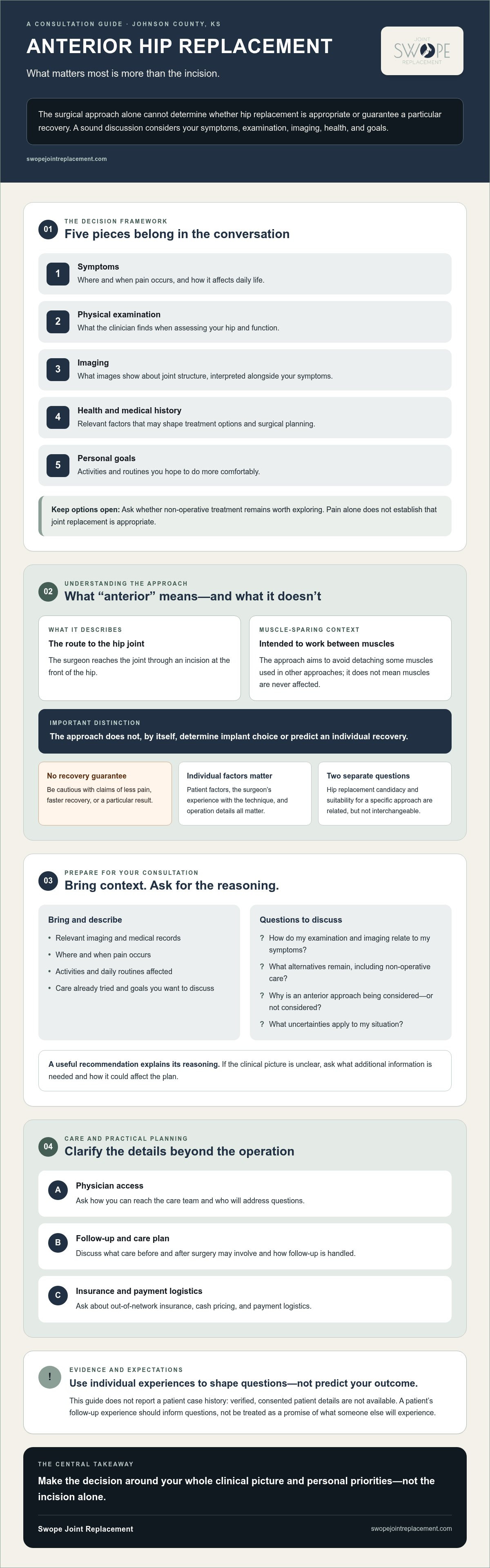
What matters most when considering anterior hip replacement in Johnson County, KS? It is not just the incision. The decision should reflect your symptoms, examination, imaging, health, and goals. The surgical approach alone cannot determine whether hip replacement is appropriate or guarantee a particular recovery.
You deserve an evaluation that considers how hip pain affects your daily life, what your imaging shows, and whether non-operative treatment remains worth exploring. You also deserve a clear explanation of what muscle-sparing means and what it does not guarantee. Because a verified, consented patient history is not available for this article, it does not invent one. Instead, it outlines the decisions and care considerations that can help you prepare for your own consultation.
Use this guide to plan what to discuss with a surgeon, understand what care before and after surgery may involve, and ask about physician access, out-of-network insurance, cash pricing, and payment logistics. If you’re researching anterior hip replacement in Johnson County, KS, the goal is to help you approach a consultation with Dr. Ryan Swope at Swope Joint Replacement informed and prepared to make your own decisions.
Table of Contents
How a Johnson County Patient Reached the Hip Replacement Decision
A patient story should be based on verified details, not assumptions. No consented case history or medical-record findings are available for this article, so it would be misleading to invent a Johnson County patient’s symptoms, treatment history, or outcome. Those details belong in a case study only when confirmed and approved for publication. The decision-making process can still offer a useful framework for anyone considering anterior hip replacement in Johnson County, KS.
What symptoms and goals prompted an orthopaedic evaluation?
In a documented case, the starting point is the patient’s account: where and when pain occurs, which activities have become difficult, what care has already been tried, and what the person hopes to do more comfortably. Walking, household routines, and other daily priorities may be relevant, but a case study should include them only when the patient reported them and the record supports them.
Persistent pain deserves attention, but pain alone does not establish that joint replacement is appropriate. A surgeon considers the patient’s history alongside an examination, imaging, overall health, and the effect of symptoms on function. The discussion should also cover whether non-operative treatment remains reasonable. The aim is to match the treatment decision to the individual, not to assume that everyone with hip pain needs surgery.
What does anterior hip replacement mean?
In anterior hip replacement, the surgeon reaches the hip joint through an incision at the front of the hip. The approach is intended to work between muscles rather than detach some muscles used in other approaches, but it does not mean muscles are never affected. A general overview of hip replacement surgery can help explain how the procedure replaces damaged joint surfaces.
The approach describes the route to the joint. It does not, by itself, determine implant choice or predict how an individual will recover. Patient factors, the surgeon’s experience with the technique, and the details of the operation all matter. Treat claims that an approach guarantees less pain, a faster recovery, or a particular result cautiously.
For a local consultation, bring relevant imaging and records, describe the activities you want to return to, and ask how the examination and imaging relate to your symptoms. Ask what alternatives remain, why an anterior approach is or is not being considered, and what uncertainties apply to your situation. A useful conversation explains the reasoning behind the recommendation rather than promising a result based on the incision alone.
How the Johnson County Evaluation Shaped the Treatment Plan
A treatment plan should reflect both clinical findings and the patient’s priorities. Without approved case records describing a specific patient’s examination, imaging, diagnosis, medical history, and treatment discussion, it would not be responsible to claim why a particular plan was chosen. The evaluation framework below can help you understand what should inform that decision and what to ask during a consultation.
Which findings can inform a hip replacement discussion?
A clinician considers several pieces of information together: the patient’s description of pain and its effect on daily function, physical examination findings, hip imaging, relevant medical history, and overall health. No single detail provides the whole answer. The treating clinician interprets the findings in context, explains how they relate to the patient’s concerns, and discusses whether non-operative treatment or surgery merits consideration.
Imaging helps show joint structure, but it does not describe the full experience of living with pain. Symptoms and function matter too. If the clinical picture is unclear, ask what additional information is needed and how it could affect the recommendation. Candidacy for hip replacement and suitability for a particular surgical approach are related questions, but they are not interchangeable.
How did the patient’s priorities affect the plan?
Without verified records and patient consent, this article cannot report how a specific patient’s priorities shaped a treatment plan. A complete case study should document the patient’s stated goals and concerns, the options discussed with the physician, and the reasoning behind the patient-specific plan. It should also explain uncertainties rather than presenting one choice as best for everyone. Your goals deserve a place in the conversation, whether they involve walking, work, home routines, or another meaningful activity.
For your appointment, bring prior imaging and a concise account of what has become difficult, what care you have tried, and what you hope to regain. Ask how the findings support the recommendation, what alternatives remain, and what factors could change the plan. You can also ask the practice whether it has additional patient information about direct anterior hip replacement in Overland Park.
Patients considering anterior hip replacement in Johnson County, KS, can ask how the surgeon’s evaluation process works and how direct physician access fits into care. Swope Joint Replacement operates outside in-network insurance arrangements and offers out-of-network options and cash pricing. You can review the practice’s orthopaedic care information and clarify consultation and payment details directly.
Anterior Hip Replacement: Benefits, Trade-Offs, and Individual Fit
The anterior approach is one route to the hip joint, not a guarantee of an easier recovery. It reaches the joint from the front, while other approaches use different access routes, such as the back or side. The right choice depends on your health, anatomy, goals, and the surgeon’s experience with the approach. A label such as “minimally invasive” does not tell you on its own which option is right for you.
Does the anterior approach mean faster recovery for everyone?
No. The anterior approach is intended to work between muscles, but that does not mean muscle tissue is never affected or that recovery follows a set timeline. Your health, the details of surgery, rehabilitation, and other clinical factors all shape recovery. A possible approach-related benefit is not a promise of less pain, faster progress, or a particular result. Ask your surgeon what the approach may mean in your circumstances and what uncertainties to keep in mind.
Potential advantages: The access route may allow the surgeon to work between certain muscles. Whether that offers a meaningful benefit for you depends on your clinical situation and the surgeon’s assessment.
Limitations: No approach removes the risks of surgery or guarantees a specific recovery. The anterior route may not be the best fit for every patient, and a surgeon’s familiarity with the technique matters.
Questions to ask: Why do you recommend this approach for my anatomy, health history, and goals? What alternatives should I consider? What risks and uncertainties apply to me, and what is your experience performing this procedure?
What should patients ask about approach and surgeon experience?
Ask for an explanation based on your situation, not a broad claim that one approach is always superior. The surgeon should be able to discuss why the recommended route may fit your case, what trade-offs it involves, and how their experience informs the plan. You can also ask what might lead them to recommend a different approach and how follow-up and rehabilitation expectations will be discussed.
If you are comparing approaches, bring your questions to the consultation and ask the surgeon to explain the options in relation to your examination, imaging, and goals. That can be more useful than relying on a general comparison or an approach label alone.
If you are weighing anterior hip replacement in Johnson County, KS, use your consultation to understand both the reasoning and uncertainty behind a recommendation. A considered decision should reflect your priorities and clinical evaluation, not a marketing label or a promise about recovery.
Planning Anterior Hip Replacement Care in Johnson County
A thoughtful plan starts before surgery is scheduled. Whether you are considering anterior hip replacement in Johnson County, KS, from Overland Park or another nearby community, prepare to discuss your health, priorities, treatment options, and practical arrangements. Swope Joint Replacement serves patients in Overland Park, Kansas City, Olathe, Lee’s Summit, Lenexa, Leawood, Blue Springs, and Independence. Confirm the current practice location and appointment details directly with the practice.
What should you bring to a local consultation?
Ask the practice which records it needs and how to provide them. Relevant hip imaging and reports, a current medication list, and notes about your medical history can help the surgeon understand your situation. Write down the activities you hope to return to and the concerns you most want to address. Confirm appointment requirements directly rather than assuming records will transfer automatically.
Use your question list to cover the full decision, not just the procedure:
What do my examination and imaging show, and how do they relate to my symptoms?
What non-operative options remain, and what are the risks and trade-offs of surgery?
Why might an anterior approach suit my circumstances, and what alternatives should I consider?
What should I expect from recovery planning, follow-up, and access to the care team?
These questions help you understand how the recommendation connects to your goals. Take time to discuss uncertainties, including factors that may affect the plan or recovery.
How can you understand out-of-network and cash-pay options?
Swope Joint Replacement operates outside in-network insurance arrangements. The practice offers out-of-network options and cash pricing, but your insurer determines whether any out-of-network benefits apply to your plan. Before making a decision, request current written pricing from the practice and ask your insurer about your specific benefits, required documentation, and any reimbursement process. Do not assume coverage, reimbursement, or a particular payment outcome.
Clarify what the written pricing covers and whether separate care-related charges may apply. Ask who can answer payment questions, how payment is handled, and whom to contact about follow-up logistics. Confirm these details before scheduling so you can consider the financial and clinical parts of the decision together.
A simple sequence can keep planning clear: gather your records, identify your goals, review treatment options with the surgeon, confirm location and appointment requirements, clarify pricing and insurance questions, then discuss follow-up arrangements. If you are ready to talk through your circumstances and care logistics, contact Swope Joint Replacement.
The Patient’s Follow-Up and Next Steps with Swope Joint Replacement
A case study’s follow-up should be documented as carefully as the decision that led to surgery. No verified patient timeline, follow-up notes, or approved patient-reported experience are available for this article. It therefore cannot responsibly describe a specific recovery, milestone, or result. A published patient story should include only details confirmed in the medical record and shared with the patient’s consent.
What can a responsible case study say about recovery?
A well-supported account may describe documented follow-up visits, care recommendations, and the patient’s own approved description of their experience. It should identify the basis for each detail and avoid turning one person’s experience into a prediction for others. Individual recovery and results vary based on personal health, the procedure, and other factors.
Be cautious of language that promises a pain-free recovery, complete recovery, or a set timeline. A patient’s account can offer perspective, but it cannot guarantee what another person will experience. The same care applies to comparisons: without verified evidence and context, a case study should not claim that one approach or care model produced a better outcome.
How can a Johnson County patient start a conversation?
If you are considering anterior hip replacement in Johnson County, KS, contact the practice to ask about requesting a consultation and confirm current scheduling and location details. Bring your questions and relevant records. Ask the surgeon whether replacement may suit your circumstances, what alternatives remain, and what risks and uncertainties apply to the plan.
Swope Joint Replacement’s concierge orthopaedic model includes direct access to the physician. This describes how the practice structures care, not a promise about surgical results. Ask who you will speak with, how follow-up is arranged, and how questions are handled during your care.
Clarify payment before making decisions. The practice operates outside in-network insurance arrangements and offers out-of-network options and cash pricing. Request current written pricing and check with your insurer about any out-of-network benefits. Coverage or reimbursement is not guaranteed, so confirm what applies to your plan.
You do not need to arrive with a decision already made. A measured first conversation can help you understand candidacy, alternatives, care logistics, and payment options. If you would like to explore those questions with Swope Joint Replacement, contact the practice and confirm its current consultation process.
Take the Next Step with Clarity
The right hip replacement decision begins with your symptoms, examination, imaging, health, and goals. The anterior approach is one way to reach the joint, not a promise of less pain or a faster recovery. A careful conversation should also cover alternatives, risks, follow-up, and practical details of care.
If you are exploring anterior hip replacement in Johnson County, KS, Swope Joint Replacement offers direct anterior hip replacement and revision surgery through a personalized concierge practice with direct physician access. The practice operates outside in-network insurance arrangements and offers out-of-network options and cash pricing. Ask the practice to confirm current pricing and logistics, and check with your insurer about any out-of-network benefits.
You do not need to arrive with every answer. Bring your questions and discuss what matters to you. Request a consultation to discuss your hip care options and take a considered next step toward a plan that fits your circumstances.
Frequently Asked Questions
Is anterior hip replacement right for everyone?
No. Candidacy depends on your symptoms, physical examination, imaging, health history, and the surgeon’s assessment of your circumstances. The anterior approach is not automatically the best option for every patient. During a consultation, discuss whether replacement is appropriate, what alternatives may be available, and the risks and recovery considerations of each option. Your priorities matter too. This article can help you prepare questions, but it cannot diagnose your condition or determine whether you are a candidate.
Can anterior hip replacement guarantee a faster recovery?
No surgical approach can guarantee a particular recovery speed or outcome. Recovery may vary with your health, the details of surgery, rehabilitation, and other individual factors. Potential benefits describe possibilities, not promises about what will happen for you. Ask the surgeon what recovery may involve given your health and treatment plan, what factors could affect progress, and how follow-up can address questions as you recover.
How do I find an anterior hip replacement surgeon in Johnson County, KS?
Review the surgeon’s experience with the approach and ask why it may suit your health, anatomy, and goals. Discuss risks, alternatives, follow-up, and how you will have access to the physician. Patients in Overland Park, Kansas City, Olathe, Lee’s Summit, Lenexa, Leawood, Blue Springs, and Independence can confirm current consultation and location details with Swope Joint Replacement. Ask directly about the care pathway before deciding.
What happens if I am not a candidate for anterior hip replacement?
If the anterior approach is not appropriate, your surgeon may discuss another surgical approach, continued non-operative care, or additional evaluation, depending on the clinical findings. The right next step varies by patient. Ask what the evaluation shows, why a particular option is being considered, and what benefits, risks, and uncertainties apply. One approach is not the only possible path, and a recommendation should reflect your health, symptoms, and priorities.
Does Swope Joint Replacement accept in-network insurance?
No. Swope Joint Replacement operates outside in-network insurance arrangements. The practice offers cash pricing and out-of-network options, but any coverage or reimbursement depends on your individual plan and insurer. Before making decisions, request current written pricing from the practice and contact your insurer to ask about out-of-network benefits and documentation requirements. Confirm payment details with the practice as well, since coverage or reimbursement is not guaranteed.
What should I ask at an anterior hip replacement consultation?
Ask whether hip replacement may be appropriate, why the surgeon is considering a particular approach, and what alternatives are available. Discuss risks, recovery planning, the surgeon’s experience, direct physician access, follow-up, and payment arrangements. Bring relevant imaging, medical history, a current medication list, and notes about the activities you hope to resume. A prepared list of questions can help you leave with a clearer understanding of the recommendation and next steps.


Comments