Direct Physician Access in Orthopedics: What Patients Should Know

What if the physician guiding your orthopaedic care were also the person you could speak with when questions arise? If you’re researching “direct physician access orthopedics,” the key question is how that access shapes your care beyond the appointment itself.
It’s reasonable to want clear answers, continuity, and enough time to understand your options. In a larger care team, different professionals may support different parts of your treatment, and you may wonder who is responsible for guiding clinical decisions. Direct physician access makes the physician relationship central to your care while still allowing other team members to contribute where appropriate.
This article explains what direct physician access means in orthopaedic care, what it doesn’t promise, and what communication and continuity you can reasonably expect from a physician-led model. You’ll also learn how this approach differs from team-based care, so you can decide which structure fits your needs.
Table of Contents
What Does Direct Physician Access Mean in Orthopedics?
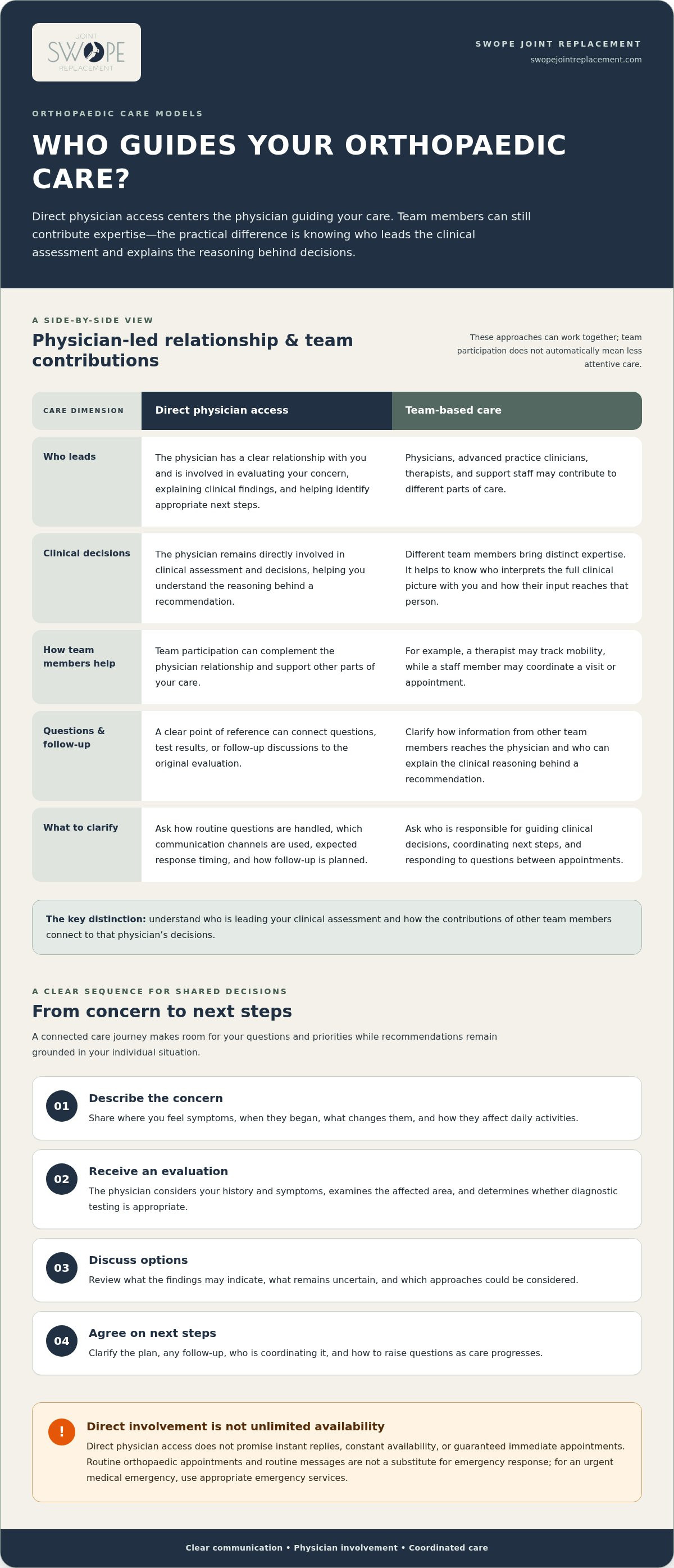
Direct physician access means having a clear relationship with the physician guiding your orthopaedic care. The physician is involved in evaluating your concern, explaining clinical findings, and helping you understand appropriate next steps. The key is knowing who is leading your clinical assessment and how your questions connect to that person’s decisions.
That distinction can matter when a diagnosis is unfamiliar or several treatment paths are possible. You may want to understand what an imaging result means, why a particular option is being considered, or what to do if symptoms change before follow-up. A direct relationship gives those conversations a clear point of reference. It doesn’t determine which treatment is right for you, but it can help you understand the reasoning and participate in decisions.
The phrase “direct access” is also used for different care models. For example, Direct Primary Care (DPC) describes a primary-care model, not a definition of orthopaedic practice. In orthopaedics, focus on what physician involvement looks like in your care rather than assuming every practice uses the same structure.
How is direct physician access different from seeing a care team?
Orthopaedic care can involve physicians, advanced practice clinicians, therapists, and support staff. Each may contribute expertise, from assessing a concern and discussing treatment choices to supporting rehabilitation or coordinating appointments. In a physician-led model, the physician remains directly involved in clinical assessment and decisions. Team participation can complement that relationship; it doesn’t automatically mean less attentive care.
For you, the practical distinction is knowing who can explain the clinical reasoning behind a recommendation and how information from other team members reaches that person. A therapist may track your mobility or a staff member may coordinate a visit. Those contributions support care, but they are distinct from knowing who is responsible for interpreting the full clinical picture with you.
Does direct access mean a physician is available at all times?
No. Direct physician involvement describes the care relationship, not unlimited availability, instant replies, or guaranteed immediate appointments. Clarify how routine questions are handled, which communication channels are used, what response timing to expect, and how follow-up is planned. Clear expectations can prevent uncertainty when a question arises between appointments.
Routine orthopaedic appointments are not a substitute for emergency response. If you’re facing an urgent medical emergency, use appropriate emergency services rather than waiting for a scheduled appointment or routine message response. For non-emergency concerns, understanding the communication process helps you know where to direct questions and what to expect next.
How Direct Physician Access Can Shape an Orthopaedic Care Journey
Orthopaedic care often involves a series of connected decisions, not a single appointment. Direct physician access orthopedics can create a clear line between your concern, the clinical evaluation, and the discussion of what to do next. The process should leave room for your questions and priorities, while recommendations remain grounded in your individual situation.
Describe the concern. Share where you feel symptoms, when they began, what changes them, and how they affect daily activities.
Receive an evaluation. The physician considers your history and symptoms, performs an examination, and determines whether diagnostic testing is appropriate.
Discuss options. Review what the findings may indicate, what remains uncertain, and which approaches could be considered.
Agree on next steps. Clarify the plan, any follow-up, and how to raise questions as care progresses.
This sequence gives you an opportunity to understand the reasoning behind a recommendation rather than simply receiving instructions. You might explain that knee discomfort makes stairs difficult or that a shoulder problem limits a particular activity. Those details help frame a conversation about goals and practical options; they don’t predetermine a diagnosis or treatment.
What happens during an initial orthopaedic evaluation?
An initial evaluation starts with your story: symptoms, relevant medical history, daily limitations, and what you hope to be able to do. The physician may examine the affected area and decide whether imaging or other diagnostic testing would help clarify the concern. The assessment depends on your symptoms and clinical judgment, not a fixed checklist applied to every patient.
A useful discussion distinguishes what the evaluation suggests from what is not yet clear. Depending on the situation, next steps might include further imaging, non-operative treatment, therapy, a procedure, or coordination with another clinician. Ask what each step is intended to clarify or address before deciding how to proceed.
How can physician involvement continue after the first appointment?
Care decisions may develop as new information becomes available or as you consider the options discussed. A follow-up conversation can revisit your response to a treatment plan, explain test results, or address questions that came up after the visit. Having a clear point of contact connects those discussions to the original evaluation, though follow-up arrangements vary with practice structure and patient needs.
Before leaving an appointment, make sure you understand the next step, who is coordinating it, and how to share a question or update. For a broader example of a care model addressing chronic musculoskeletal pain, the CMS ACCESS Model describes an initiative focused on care for complex conditions. It is a distinct model, but illustrates why clear coordination matters. Patients considering physician-led orthopaedic care can use these questions to make their priorities part of the discussion.
Direct Physician Access and Team-Based Orthopaedic Care: What Is the Difference?
These care models aren’t simple opposites. A team-based practice can include a physician who leads assessment and decisions, while a direct physician relationship can still involve other clinicians and staff. The meaningful difference is how care is organized: who maintains the clinical overview, how different professionals’ input is coordinated, and how you understand the next step. With direct physician access orthopedics, continuity with the physician is central, not a claim that other expertise is unnecessary.
Use this comparison as a guide, not a universal description. Practices structure responsibilities and communication differently.
What can a team-based model offer?
A coordinated team can bring distinct perspectives to different parts of care. A physician may assess the concern and guide treatment decisions, while an advanced practice clinician, therapist, or support professional contributes within their role. This can be valuable when care involves multiple services or specialties. Team participation isn’t evidence of less attention; what matters is how the team communicates and coordinates your clinical plan.
For example, evaluation, treatment planning, and rehabilitation may involve different professionals over time. A well-coordinated approach can align those contributions around your needs. The structure, roles, and handoffs depend on the practice and care involved, so a team model shouldn’t be assumed to work the same way everywhere.
When might a direct physician relationship matter most?
You may place particular value on direct physician involvement when symptoms persist, a decision is complex, or surgery is being considered. You might also prefer one physician to remain a consistent point of reference as you discuss findings and weigh options. That preference is valid, but it doesn’t guarantee a particular result or make one model right for every patient.
Consider what helps you feel informed: a measured discussion, continuity with the clinician guiding decisions, access to complementary expertise, or coordinated support across services. Your clinical needs and personal preferences both matter. Compare the practice’s actual model, including who leads decisions and how the team supports communication and follow-up.
How to Understand Your Access, Communication, and Payment Expectations
A clear care relationship includes more than knowing which physician guides your treatment. You should also understand how routine questions are handled, how follow-up is arranged, and what payment terms apply. Use this checklist to make your expectations concrete before or during an appointment:
Communication: Which channel should you use for routine questions, and who will respond?
Results: How will you receive and discuss imaging or test results?
Follow-up: What is the planned next step, and who is coordinating it?
Decisions: Who will explain treatment options and the clinical reasoning?
Payment: Is care handled through out-of-network benefits or cash pricing, and what plan-specific details may affect your costs?
Prepare for the visit, too. Bring a current medication list, relevant prior records, and existing imaging or reports if available. Note when symptoms began, what affects them, and how they limit daily activities. Write down your questions so you can focus the appointment on what matters most to you.
What should you clarify about communication and follow-up?
Before you leave, make sure you can describe the agreed next step in your own words. Note who to contact with a non-emergency question and how results or follow-up will be handled. Routine messages and scheduled appointments aren’t emergency services. If you’re experiencing a medical emergency, seek appropriate emergency care rather than relying on routine orthopaedic communication.
How do out-of-network and cash-pay arrangements affect expectations?
In-network care generally means a clinician or practice participates in a health plan’s contracted network. Out-of-network care is outside that network, so your plan may handle coverage and reimbursement differently. Cash pricing means paying the stated cash price for care rather than using in-network billing. These arrangements are distinct, and out-of-network benefits don’t guarantee reimbursement. Coverage depends on your individual plan terms and payer decisions.
Swope Joint Replacement operates outside in-network insurance arrangements and offers transparent cash pricing alongside out-of-network insurance options. The out-of-network orthopaedic benefits guide can help you identify relevant insurance questions and understand the distinction between benefits and payment arrangements. For more about the local model, the concierge orthopaedic care guide describes what to expect from physician-led care.
Understanding communication and payment can help you decide whether direct physician access orthopedics fits your priorities. Explore Swope Joint Replacement’s concierge orthopaedic care to learn about its physician-led approach.
Direct Physician Access at Swope Joint Replacement in the Kansas City Area
For patients considering direct physician access orthopedics, Swope Joint Replacement offers a concierge care model centered on a direct relationship with the physician guiding care. The practice serves Overland Park and the wider Kansas City area, including Olathe, Lee’s Summit, Lenexa, Leawood, Blue Springs, and Independence. Its approach emphasizes personalized attention and physician involvement without suggesting unlimited availability or immediate appointments.
Orthopaedic concerns can affect how you move, work, and manage daily routines. A care discussion should make space for those details. At Swope Joint Replacement, the physician is directly involved in care rather than delegating that relationship, helping you discuss your concerns and understand the clinical thinking behind recommendations.
What does the concierge approach mean for a patient's experience?
Concierge orthopaedic care is a physician-led, individualized approach. Your evaluation and treatment discussion can take your symptoms, medical history, and priorities into account. Depending on your assessment, care may involve operative or non-operative options. The aim is to make the plan responsive to your circumstances, not to promise a particular treatment or outcome.
Swope Joint Replacement provides hip and knee replacement, revision hip and knee surgery, fracture care, general orthopaedic care, and non-operative treatment options. The right direction depends on the concern and clinical evaluation. A conversation about surgery can include whether it is appropriate to consider, while non-operative approaches may also be part of an individualized plan.
The practice operates outside in-network insurance arrangements and offers transparent cash pricing alongside out-of-network insurance options. These are distinct payment approaches. Whether an insurance plan provides out-of-network benefits, and how it handles reimbursement, depends on the plan and payer decisions. Understanding the financial arrangement is one part of making an informed choice about care.
How can Kansas City-area patients take a next step?
A little preparation can make an appointment more useful. Before your visit, write down what concerns you most, which activities are affected, and what you hope to understand or achieve. Bring a current medication list, relevant medical records, available imaging, and questions you want to discuss. These details help frame a focused conversation around your needs.
If you’re exploring local concierge orthopaedic care, the Overland Park orthopaedic care guide offers more context about this model. As you consider your options, look for an approach that clearly explains physician involvement, treatment discussions, communication, and payment expectations. Your preferences and clinical needs both belong in that decision.
Explore personalized orthopaedic care with Swope Joint Replacement to learn more about the practice’s care approach and next steps.
Choose the Care Relationship That Fits You
Your next step can be simple: decide what helps you feel informed and involved in your care. Consider whether a continuing relationship with the physician guiding your decisions matters to you, and whether you value a measured conversation about your concerns and goals. These preferences can help you assess whether direct physician access orthopedics suits the care experience you want.
Swope Joint Replacement’s concierge model includes direct physician access without delegation. Serving Overland Park and the Kansas City area, the practice offers transparent cash pricing and out-of-network insurance options. Understanding the clinical relationship and payment approach can help you move forward with greater clarity.
You don’t need to have every question answered before taking a next step. Bring your priorities and concerns to the conversation, and take the time you need to understand your options.
Explore personalized orthopaedic care with Swope Joint Replacement to learn about its physician-led approach.
Frequently Asked Questions
What is direct physician access in orthopedics?
Direct physician access in orthopaedics means the physician guiding your care is directly involved in clinical discussions with you. Ask who will review findings and explain recommendations, especially if imaging or a proposed treatment raises questions. For example, clarify how results are shared and whether you’ll discuss their meaning with the physician. The term direct physician access orthopedics describes a care relationship, not a promise of instant appointments or constant availability.
Does direct physician access mean I will only see the surgeon?
No. Your care may involve other clinicians who contribute to assessment, treatment, rehabilitation, or coordination. For instance, a therapist may guide exercises while the physician remains involved in decisions about the overall plan. Roles depend on your needs and the practice’s structure. Find out which clinician handles each part of care and how relevant updates reach the physician guiding your treatment.
Can I contact my orthopaedic physician between appointments?
Practices may have a process for routine questions between visits, but the communication channel and availability depend on the practice. Before you leave, note how to send a non-emergency question and what to do if you have a concern about a test result or care instruction. Direct physician access doesn’t mean around-the-clock coverage. For a medical emergency, seek emergency services rather than waiting for a routine orthopaedic response.
Is direct physician access better than team-based orthopaedic care?
Neither approach is automatically the better choice for every patient. A team can bring complementary expertise, while a direct physician relationship may appeal if you value continuity with the clinician making key decisions. Think about how you prefer to receive explanations, how complex your care may be, and whether several services need coordination. The practice’s actual communication and decision-making structure matters more than the model’s label.
Does direct physician access change how orthopaedic care is paid for?
Not by itself. Physician access describes how care is organized, while in-network, out-of-network, and cash-pay arrangements describe payment. Swope Joint Replacement operates outside in-network arrangements and offers out-of-network insurance options and cash pricing. Coverage or reimbursement depends on your individual plan and payer decisions. The practice serves patients in Overland Park, Kansas City, Olathe, Lee’s Summit, Lenexa, Leawood, Blue Springs, and Independence.
What should I bring to an orthopaedic appointment?
Bring your medication list, relevant medical history, prior records, and any available imaging or reports. A short timeline can help: note when the concern began, what has changed, and which activities are affected. Include treatments you’ve already tried and how they went. Write down your top questions, such as what the evaluation may involve or what decisions might follow, so you can refer to them during the visit.


Comments