How to Choose a Knee Surgeon in Kansas City by Location

There are 230 doctors who perform knee replacement within a 12-mile radius of Kansas City, Kansas. Choosing among them means looking beyond the closest address: compare travel distance, knee-replacement experience, relevant specialties, and each surgeon’s physician profile. The most useful way to decide how to choose a knee surgeon in Kansas City is to weigh those factors together, not rely on location or ratings alone.
Distance matters because you’ll need to travel for appointments and follow-up care, but the right fit also depends on your needs and the surgeon’s approach. This guide explains how to compare Kansas City-area locations, review a surgeon’s training and experience, and assess patient reviews in context. You’ll have a clearer basis for deciding which surgeon to learn more about.
Table of Contents
Kansas City-area orthopedic surgeons who perform knee replacement
Kansas City has a broad choice of orthopedic doctors who perform knee replacement. Compare local ratings and relevant surgical experience with the consultation and follow-up arrangements that fit your needs.
Kansas City Provider Statistics and Ratings
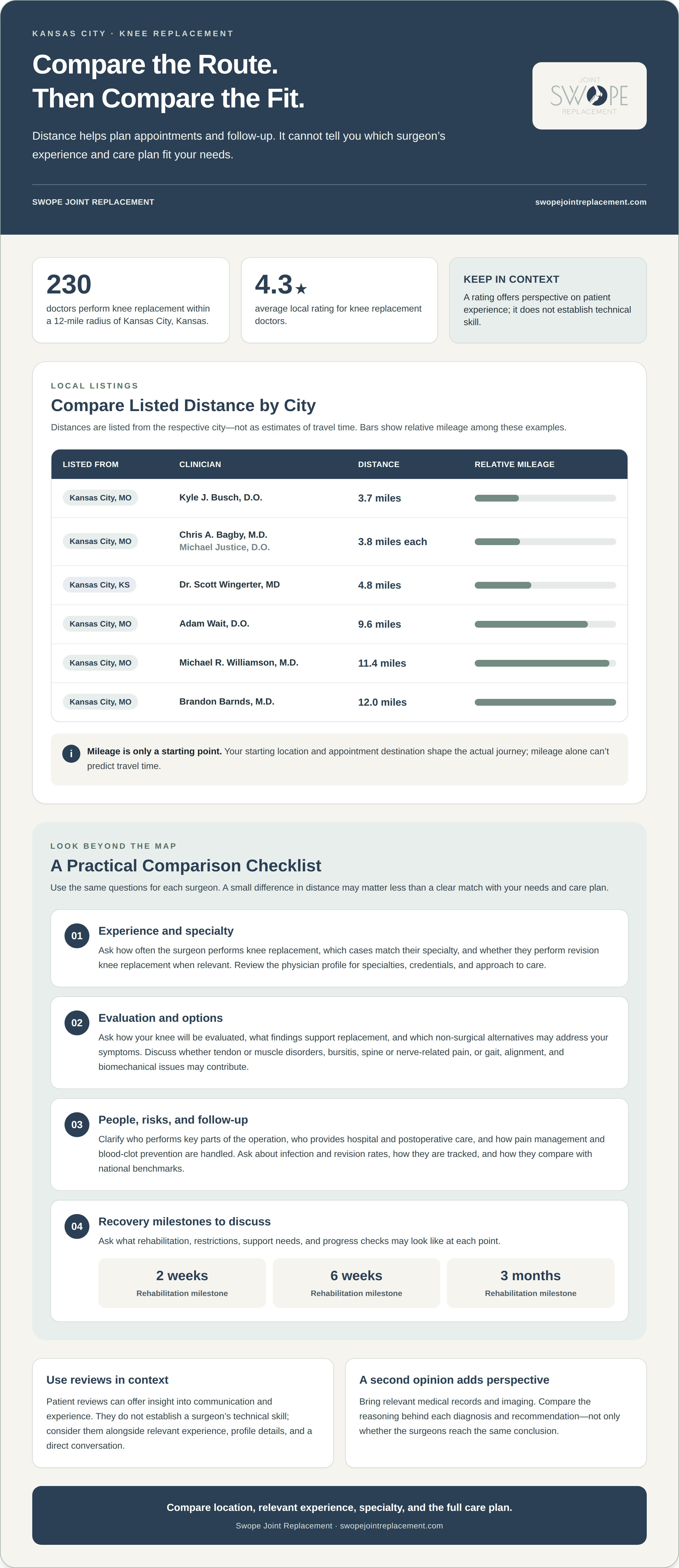
Local statistics offer context, not a verdict on an individual surgeon. There are 230 doctors who perform knee replacement within a 12-mile radius of Kansas City, Kansas, and local knee replacement doctors average 4.3 stars. These figures show the breadth of choice, but a rating alone doesn’t describe a surgeon’s experience with your needs. Review profiles for relevant specialties, then consider how the surgeon explains the proposed care plan.
Consultations, Second Opinions, and Surgical Decisions
Experience matters because knee replacement requires a surgical plan suited to your joint and circumstances. Ask how often the doctor performs knee replacement, what cases match their specialty, and how they assess your knee pain. Surgeons must stay current with surgical procedures to maintain American Board of Orthopaedic Surgery certification. A profile offers useful context, while a direct conversation can clarify the surgeon’s approach.
Ask how the surgeon will evaluate your knee, what findings support replacement, and which alternatives may address your symptoms. Also ask who performs key parts of the operation, who provides hospital and postoperative care, and how pain management and blood-clot prevention are handled. Direct answers help you understand the plan and the people involved in your care.
A second opinion gives you another professional assessment of the diagnosis and proposed treatment. Bring relevant medical records and imaging so the second surgeon can review the same information. A confident surgeon should welcome a second opinion and explain where their recommendation agrees or differs. Compare the reasoning behind each recommendation, not only whether both surgeons reach the same conclusion.
Ask the surgeon to explain the risks of knee surgery, including infection and the possibility of revision, in terms you understand. Discuss non-surgical alternatives and why replacement is being considered. Ask how the surgeon tracks infection and revision rates and how those rates compare with national benchmarks. This conversation helps you weigh the recommendation instead of treating surgery as the only option.
Recovery planning also belongs in the decision. Ask about rehabilitation milestones at 2 weeks, 6 weeks, and 3 months after joint replacement. Clarify expected restrictions, support needs, and how progress will be assessed during follow-up. These details help you consider whether the plan fits your daily responsibilities and the practical journey to appointments.
Also ask whether the surgeon performs revision hip or knee replacement, and whether they can perform a well-balanced manual replacement if robotic assistance cannot be used. These questions clarify the surgeon’s experience with different operative circumstances without assuming that a particular technique is right for every patient.
Pain attributed to arthritis may coexist with other sources, including tendon or muscle disorders, bursitis, spine or nerve-related pain, and gait, alignment, or biomechanical issues. Ask how the evaluation accounts for these possible contributors and how they affect the recommendation for knee replacement. This can make the discussion of your symptoms and treatment options more specific.
Choosing an orthopaedic knee surgeon near Kansas City
Location affects the practical effort of reaching appointments before and after knee replacement. Use distance as a starting point, then weigh it alongside the surgeon’s relevant experience, specialty, and profile. A nearby office may simplify repeated visits, but distance alone can’t establish which doctor is right for your needs. A sound approach to how to choose a knee surgeon in Kansas City considers travel alongside clinical fit.
Local listings give examples across both Kansas City, Kansas, and Kansas City, Missouri. The distances below are listed from the respective city, not estimates of travel time:
Dr. Scott Wingerter, MD, is listed 4.8 miles from Kansas City, Kansas.
Kyle J. Busch, D.O., is listed 3.7 miles from Kansas City, Missouri.
Chris A. Bagby, M.D., and Michael Justice, D.O., are each listed 3.8 miles from Kansas City, Missouri.
Adam Wait, D.O., is listed 9.6 miles from Kansas City, Missouri.
Michael R. Williamson, M.D., is listed 11.4 miles from Kansas City, Missouri.
Brandon Barnds, M.D., is listed 12.0 miles from Kansas City, Missouri.
These examples show why it helps to define your starting point first. If you live or work on the Missouri side, compare the Missouri listings with your usual route. From Kansas City, Kansas, consider whether a closer Kansas-side office makes appointments easier. Your actual journey depends on where you start and the appointment location, so mileage alone can’t predict travel time.
Next, consider how location fits into the full care plan. Knee replacement involves consultations and follow-up, so think about how easily you can reach the office and the place where care will be provided. Ask how postoperative visits are arranged and who will be involved in your care. These details make the location comparison more useful than simply sorting names by distance.
A physician profile can help distinguish nearby options. Look for details about orthopedic practice, knee replacement, and revision knee replacement experience. If a profile describes general orthopaedic care, assess whether it also explains the surgeon’s focus on joint replacement. A clear specialty match may matter more than a small difference between listings such as 3.7 and 3.8 miles.
To decide how to choose a knee surgeon in Kansas City, compare each option using the same criteria: location, relevant surgical experience, profile details, and how the care plan is explained. For example, assess the 3.7-mile listings alongside the 3.8-mile listings without treating proximity as a quality measure. If you’re seeking individualized orthopaedic care, consider how direct physician attention fits your priorities alongside travel convenience.
Knee surgeon specialties and physician profiles
A physician profile can help you connect a surgeon’s training and specialty with your knee replacement needs. Read it as a starting point for a focused appointment, not a substitute for discussing your treatment plan.
Board Certification and Fellowship Training
Board certification and fellowship training describe distinct parts of an orthopedic surgeon’s professional preparation. The American Board of Orthopaedic Surgery awards certification after extensive training and rigorous examinations. An orthopedic surgeon may also complete 1-2 years of additional fellowship training after residency. These details help patients understand a physician’s credentials and specialized focus. Use the profile to identify those details, then ask the surgeon how the training relates to knee replacement.
Certification matters because it reflects a formal process beyond a general physician listing. Surgeons must stay up-to-date on surgical procedures to maintain American Board of Orthopaedic Surgery certification. A profile may also describe a fellowship or a practice focus in joint replacement. At an appointment, ask what that experience includes and how it informs the surgeon’s recommendations for your knee.
Credentials and Disciplinary History
A credentials review brings together a surgeon’s education, certification, and stated areas of practice. It helps you distinguish a general orthopedic profile from one that describes knee replacement or revision surgery. Read the physician’s name and qualifications carefully, then discuss any unclear credential or disciplinary-history entry during your appointment. Ask for a plain-language explanation of its relevance to the care being considered.
Look for consistency across the physician profile and the surgeon’s explanation. For example, if a profile highlights joint replacement, ask how that focus applies to your diagnosis and proposed procedure. If you see a disciplinary-history entry, ask what it refers to and how it relates to current practice. A clear discussion helps place credentials in context instead of drawing conclusions from a label alone.
Profiles can also help you prepare specific questions. Note whether the surgeon describes knee replacement, revision procedures, or a broader orthopedic practice. Then ask how the surgeon assesses your knee, what findings guide treatment, and what alternatives may fit your condition. That conversation connects a listed specialty to the decision you face, rather than treating a profile as a complete account of care.
During the appointment, clarify who will perform key parts of the operation and who will provide hospital and postoperative care. Ask how the surgeon chooses implant systems and approaches fixation, including cemented or cementless options. These questions help you understand the surgeon’s decision-making, not simply the credentials listed online. A useful profile gives you a starting point; the consultation should explain how experience connects to your treatment plan.
A physical exam and imaging such as X-ray or MRI can help identify the cause of knee pain and guide treatment. Physical therapy may help strengthen the knee and improve flexibility after an injury.
How can patients verify a knee surgeon’s board certification and fellowship training in Kansas City?
Start with the surgeon’s physician profile, then use the consultation to clarify credentials and training. Board certification and fellowship training describe different parts of an orthopedic surgeon’s professional background. Checking both can help you understand whether a profile reflects general orthopedic practice or additional focus relevant to knee replacement.
The American Board of Orthopaedic Surgery awards board certification to surgeons who complete extensive training and rigorous examinations. Review the surgeon’s profile for the certification and the exact name listed. If the profile doesn’t explain the credential clearly, ask the surgeon to describe their certification and what it represents. Keep the discussion specific to the doctor you’re considering, since credentials belong to individual physicians, not an entire practice.
Fellowship training is additional specialized training after residency. Orthopedic surgeons who complete a residency may undertake 1-2 years of fellowship training. Read the profile for the fellowship’s stated focus, then ask how that training relates to knee replacement. A fellowship in a relevant area can provide useful context, but its name alone doesn’t tell you how the surgeon approaches your diagnosis or proposed procedure.
Use a short checklist to organize what you find:
Match the physician’s name on the profile to the surgeon you’ll meet.
Note whether the profile identifies American Board of Orthopaedic Surgery certification.
Record any fellowship training and its stated specialty.
Ask how the listed training informs the surgeon’s knee replacement recommendations.
At your appointment, ask the surgeon to explain any unfamiliar credential in plain language. For example, if a profile names a fellowship but not its focus, ask what the training covered and how it applies to your care. You can also ask whether the surgeon’s current practice includes primary or revision knee replacement. These questions connect a title on a profile with the expertise relevant to your decision.
Certification and fellowship training are useful comparison points, not a complete measure of a surgeon’s fit. Pair them with the proposed treatment plan, the surgeon’s explanation of alternatives, and details about who will provide postoperative care. If Kansas City-area profiles show similar credentials, use the consultation to understand how each surgeon evaluates your knee and explains the reasoning behind a recommendation. A clear answer should help you see how training informs the care being proposed.
How can patients check a Kansas City knee surgeon’s credentials, disciplinary history, and patient reviews?
Review credentials, disciplinary information, and patient feedback as separate parts of a surgeon’s profile. Each offers a different kind of context, so one should not stand in for the others.
Start by matching the physician’s full name and credentials across the profile and appointment materials. This helps distinguish surgeons with similar names and ensures you’re reviewing the right person. Note the listed specialty and whether the physician’s profile describes knee replacement. If a credential or practice detail is unclear, ask the surgeon to explain it in plain language during your consultation.
For disciplinary history, look for official information tied to the individual physician rather than relying on a search result summary. Read the entry carefully and note what it describes, when it occurred, and whether it shows a final action or another kind of record. If the meaning is unclear, ask the physician directly for context. Avoid treating an unfamiliar term or isolated entry as proof of current surgical ability.
Patient reviews can help you understand communication and the overall care experience. They may describe how clearly a physician explained options, responded to concerns, or coordinated appointments. Online reviews don’t necessarily reflect technical skill. A positive review can’t establish surgical performance, and a negative experience doesn’t by itself explain a surgeon’s clinical judgment.
Read several reviews for specific, repeated themes rather than relying on a single comment or overall rating. For example, note whether patients consistently mention clear explanations or difficulty getting questions answered. Separate comments about scheduling and communication from claims about surgical results. Reviews offer personal perspectives, not a complete record of how a surgeon performs or manages complex cases.
Bring any questions raised by a profile, record, or review to your consultation. Ask how the surgeon communicates changes to a treatment plan, who answers questions after surgery, and who provides follow-up care. If a review describes an experience that concerns you, ask how the same issue would be handled in your care. A direct answer gives you relevant context without assuming every patient’s experience is identical.
Keep your comparison focused: physician identity, relevant credentials, the meaning of any disciplinary record, and patterns in patient feedback. Consider whether the surgeon addresses your questions clearly and explains the reasoning behind recommendations. If you’re ready to discuss your knee replacement needs, explore knee replacement care.
Swope Joint Replacement
Swope Joint Replacement offers a place to discuss your knee replacement needs and the questions that shape your choice of surgeon. Its personalized concierge orthopaedic model provides direct access to the physician, so you can talk through your diagnosis, treatment options, and care approach. For patients with a prior knee replacement, the practice also performs Revision Knee Replacement.
Use that conversation to clarify the proposed plan, who will provide your care, and how your needs influence the recommendation. Swope Joint Replacement also offers non-operative treatment options, which may be relevant when surgery isn’t the appropriate next step. The aim is an informed discussion that gives you room to understand your choices.
To discuss your knee care and next steps, contact Swope Joint Replacement.
Take the Next Step With a Clearer Plan
Your decision about how to choose a knee surgeon in Kansas City should lead to a conversation that feels specific to you. Bring forward the concerns that matter most, whether they involve your diagnosis, treatment alternatives, recovery, or how care will be coordinated. Discuss those priorities directly to understand how they shape the options being considered.
Swope Joint Replacement offers Knee Replacement and Revision Hip Replacement, as well as Direct Anterior Hip Replacement. If you’re weighing knee surgery or seeking a clearer view of your options, a direct discussion can help you decide what to explore next. You’re in control of the pace and the questions you want answered.
Contact Swope Joint Replacement to discuss your next step with confidence.
Frequently Asked Questions
Which Kansas City knee surgeons specialize in knee replacement, arthroscopy, or sports injuries?
Local knee replacement listings include Dr. Scott Wingerter, John Eggers, Kyle J. Busch, Chris A. Bagby, Michael Justice, Adam Wait, Michael R. Williamson, and Brandon Barnds. A listing for knee replacement doesn’t establish a surgeon’s focus on arthroscopy or sports injuries. For those needs, look for the specific procedure or condition in the physician profile, then ask whether it matches your diagnosis. A torn meniscus, for example, may call for a different discussion than joint replacement.
How much experience should a knee surgeon have with the procedure I need?
Look for experience that matches your specific operation, rather than relying on a general claim of surgical experience. Ask whether the surgeon regularly performs the procedure under consideration and how their experience applies to your diagnosis. For example, primary knee replacement and revision surgery address different situations. Ask how the surgeon’s approach changes for your case, who performs key parts of the operation, and what alternatives they consider. Clear explanations help you assess fit.
How do I compare knee surgeons’ complication rates, revision rates, and patient outcomes?
Ask each surgeon to explain their complication and revision rates, how those figures are calculated, and which patients they include. Compare like with like: primary replacement rates should not be treated as equivalent to revision cases. Ask what period the figures cover and how the surgeon interprets them alongside your health and procedure. Patient reviews may describe communication and care experience, but they don’t measure technical outcomes. Discuss how outcomes are tracked and what they mean for your treatment decision.



Comments