Minimally Invasive Hip Replacement in Overland Park: What Patients Should Know

Could a smaller incision automatically mean less pain, a quicker recovery, or a better operation for you? It’s an understandable question if you’re considering minimally invasive hip replacement overland park, especially when unfamiliar terms make it hard to compare options. “Minimally invasive” generally describes how the surgeon reaches the hip, not a different type of artificial joint, and it doesn’t guarantee a particular recovery.
Your best choice depends on more than the name of an approach. Your health, anatomy, goals, and your surgeon’s experience all matter. You deserve a clear explanation of the potential benefits and trade-offs, without pressure to choose a technique based on a label.
This article explains what minimally invasive hip replacement can mean in practice, how direct anterior, posterior, and lateral approaches differ, and which factors may shape candidacy and recovery. It also outlines useful questions to bring to a consultation in Overland Park or elsewhere in the Kansas City area. Swope Joint Replacement offers direct anterior hip replacement, one option to discuss with a surgeon. The aim is to help you understand your choices and take part in a thoughtful decision about care that fits your needs.
Table of Contents
What Does Minimally Invasive Hip Replacement Mean for Overland Park Patients?
How Hip Replacement Approaches Differ, and What the Differences Do Not Prove
Does Minimally Invasive Hip Replacement Mean Less Pain or Faster Recovery?
How to Evaluate a Minimally Invasive Hip Replacement Consultation
Considering Direct Anterior Hip Replacement with Swope Joint Replacement
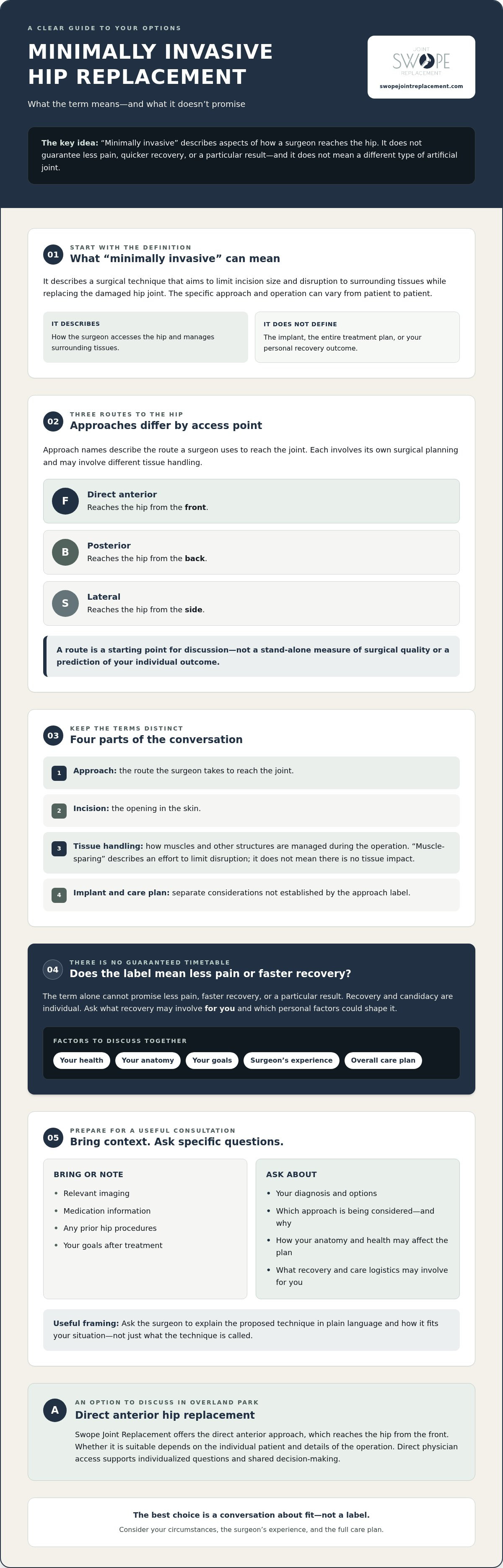
What Does Minimally Invasive Hip Replacement Mean for Overland Park Patients?
If you’re researching minimally invasive hip replacement overland park, start with what the term means rather than the promise it may seem to imply. Minimally invasive describes how a surgeon accesses the hip and handles surrounding tissues. It doesn’t guarantee less pain, a faster recovery, or a particular result.
A concise definition: Minimally invasive hip replacement is a surgical technique that aims to limit incision size and disruption to surrounding tissues while replacing the damaged hip joint. The specific approach and operation can vary from patient to patient.
Approach, incision, and tissue handling are related, but they aren’t interchangeable. The approach describes the route the surgeon takes to reach the joint. The incision is the opening in the skin, while tissue handling describes how muscles and other structures are managed during the operation. The implant and the broader treatment plan are separate considerations. Hip replacement surgery can be performed using different surgical approaches, and the terminology alone doesn’t establish the quality of care or predict an individual result.
Is minimally invasive hip replacement one specific operation?
No. The phrase can refer to different surgical techniques and approaches, rather than one standardized operation. It doesn’t identify which implant will be used or explain every part of the treatment and recovery plan. Ask the surgeon to name the approach being considered, describe how it reaches the joint, and explain why it may be appropriate for your situation.
A label isn’t a measure of surgical skill or personal suitability. Your diagnosis, anatomy, health, and the surgeon’s experience all belong in the discussion. The useful question isn’t simply whether a procedure is called minimally invasive, but how the planned operation fits your needs and what alternatives may be reasonable.
What does “muscle-sparing” mean in hip surgery?
“Muscle-sparing” generally describes an effort to reach the hip while limiting disruption to nearby muscles and tissues. It doesn’t mean there’s no impact on tissue, that surgery will be pain-free, or that recovery will follow a guaranteed timetable.
Direct anterior surgery is one approach offered by Swope Joint Replacement. The surgeon reaches the hip from the front. Whether this approach is suitable depends on the individual patient and the details of the operation. In a consultation, ask how the approach, incision, and tissue handling relate to your hip condition and what factors could affect the plan.
Before deciding, ask the surgeon to explain the proposed technique in plain language. Share relevant health conditions, prior hip procedures, and what you hope to do after treatment. That discussion can help clarify how your circumstances may influence candidacy and recovery, rather than relying on a broad label.
How Hip Replacement Approaches Differ, and What the Differences Do Not Prove
Hip replacement approaches describe the route a surgeon uses to reach the joint. The direct anterior approach accesses the hip from the front, the posterior approach from the back, and the lateral approach from the side. Each involves different surgical planning and may involve different tissue handling. The American Academy of Orthopaedic Surgeons’ overview of minimally invasive total hip replacement offers additional context on how technique can vary.
Approach names alone can’t predict an individual outcome. They don’t tell you whether a particular method is right for your anatomy, how experienced a surgeon is with it, or what your recovery plan will involve. If you’re considering minimally invasive hip replacement in Overland Park, use the approach as a starting point for questions, not as a stand-alone measure of quality.
How does the direct anterior approach differ from the posterior approach?
The main difference is the direction of surgical access: from the front with direct anterior surgery, and from the back with the posterior approach. The specific technique, tissue handling, and recovery guidance can vary by surgeon and patient. Neither route should be assumed to produce the same experience for everyone. For a focused discussion of recovery considerations, look for the article “Anterior vs Posterior Hip Replacement Recovery.”
Why does the surgical approach not tell the whole story?
Your anatomy, health history, and the reason surgery is being considered can all shape which approach is appropriate. So can factors beyond the incision, including the surgeon’s training and experience, operative planning, and follow-up. Ask how these considerations fit your case, what alternatives are reasonable, and what support to expect after surgery. A direct conversation with a physician can help you weigh the options without treating any one approach as universally best.
Swope Joint Replacement offers direct anterior hip replacement as one option for individualized discussion. You can learn more about direct anterior hip replacement and prepare questions for a conversation about whether it may fit your needs.
Does Minimally Invasive Hip Replacement Mean Less Pain or Faster Recovery?
No. A “minimally invasive” label can describe the surgical technique, but it can’t promise less pain or a quicker recovery. Your experience depends on more than the route used to reach the hip. Pain is personal, and recovery can be affected by your health, the operation, rehabilitation, and the clinical guidance you receive.
For anyone considering minimally invasive hip replacement overland park, it’s reasonable to ask what the approach may mean for your recovery. Some techniques are intended to limit disruption to surrounding tissues, but that intention shouldn’t be treated as a prediction. If you hear comparative claims about benefits, ask what is being compared and whether the information applies to patients with circumstances like yours.
Which factors can shape recovery after hip replacement?
Your starting health and the details of your hip condition help shape the care plan. So can your home environment, the support available to you, and your ability to follow rehabilitation and other clinical instructions. These factors don’t let anyone forecast your exact recovery, but they help your treating team set expectations and plan support around your needs.
Share relevant health information and practical concerns, such as stairs at home, help with daily tasks, or questions about rehabilitation. Ask which parts of the recovery plan are specific to you, what progress the team will look for, and whom to contact if you have concerns. Your surgeon and care team can explain what’s realistic for your situation rather than relying on a general timeline.
What risks and trade-offs should you ask about?
Every surgical approach involves clinical judgment and potential trade-offs. Ask the surgeon to explain the risks relevant to the proposed operation, how your health or anatomy may affect them, and what alternatives could be appropriate. You can also ask how possible complications are recognized and addressed, and what follow-up is part of the plan.
Useful questions include:
Why are you recommending this approach for me?
What factors in my health or hip anatomy could affect the decision?
What are the main risks and alternatives in my case?
How will rehabilitation and follow-up be guided?
A thoughtful conversation should make room for your concerns and clarify what is known, what varies, and what cannot be guaranteed. That gives you a more meaningful basis for comparing options than the “minimally invasive” label alone.
How to Evaluate a Minimally Invasive Hip Replacement Consultation
A useful consultation should give you a clear picture of the problem, the available options, and what care could involve for you. If you’re researching minimally invasive hip replacement overland park, approach the visit as a two-way conversation, not a test of whether you already know the right medical terms.
Before your appointment, check the clinic’s instructions. Ask whether to bring or send relevant imaging, and gather a current medication list, including supplements. Note any previous hip surgery or treatment and write down your main concerns, including which activities are difficult. A practical sequence can help:
Clarify the diagnosis: Ask what the examination and imaging show, and how they relate to your symptoms.
Review options: Discuss whether surgery is being considered and what alternatives may be appropriate.
Understand the approach: Ask why a particular route is being considered for your anatomy and health history.
Confirm care logistics: Discuss recovery guidance, follow-up, communication, and payment or insurance arrangements.
What should you ask a hip replacement surgeon?
Ask the surgeon to explain the recommendation in plain language. You might ask: “Why does this approach make sense for me?”, “What alternatives should I consider?”, and “What risks and recovery needs should I plan for?” You can also ask what experience the surgeon has with the proposed approach and who will answer follow-up questions. These prompts can guide the conversation, but they don’t replace advice based on your examination and medical history.
If a term or recommendation is unclear, ask for clarification. You deserve to understand the reasoning well enough to weigh your options and share your priorities. It can also help to write down the answers or bring someone you trust to help you remember the discussion.
How can you prepare for care near Overland Park?
Think beyond the procedure itself. If you’re traveling to Overland Park from Kansas City, Olathe, Lees Summit, Lenexa, Leawood, Blue Springs, or Independence, ask which visits require in-person attendance and plan transportation accordingly. Discuss who can help at home, how rehabilitation will be arranged, and what follow-up is expected. Confirm the clinic’s process for consultations and care coordination rather than assuming every practice handles these details the same way.
You can explore the practice’s personalized orthopaedic care model and ask directly about consultation procedures and payment arrangements. Swope Joint Replacement offers direct anterior hip replacement, with direct physician access as part of its personalized care model. For further reading, look for the guides “Direct Anterior Hip Replacement in Overland Park” and “Concierge Orthopaedic Surgeon in Overland Park.”
Considering Direct Anterior Hip Replacement with Swope Joint Replacement
If you’re exploring minimally invasive hip replacement overland park, direct anterior hip replacement may be one approach to discuss with a surgeon. Swope Joint Replacement offers this procedure through a personalized orthopaedic care model with direct physician access. This allows you to ask the physician about your diagnosis, options, and goals. It doesn’t mean the approach is suitable for every patient or promise a particular outcome.
A consultation helps determine whether hip replacement is appropriate and whether a direct anterior approach fits your circumstances. The discussion should be specific to your health and clinical history, not based on the procedure’s name alone.
What can patients discuss with the Overland Park practice?
Bring your questions and share what matters in your daily life, such as which activities are difficult and what you hope to return to. You can review your diagnosis, ask which surgical options may apply, and discuss why a particular approach is being considered. If you already have a hip implant or a relevant history of prior hip surgery, mention it. Revision surgery may be relevant in some cases, but only an individualized clinical assessment can clarify the options.
Ask the physician to explain the reasoning behind the proposed plan, alternatives to consider, and what further information may be needed before making a decision. A consultation is a chance to understand your choices; it isn’t a commitment to proceed.
What should you confirm before moving forward?
Before scheduling surgery, ask how care coordination works, what follow-up to expect, and how recovery guidance will be provided. Clarify who to contact with questions and what arrangements you’ll need for transportation, help at home, and rehabilitation. Confirm the clinic’s current instructions for appointments and any records or imaging to bring.
Review payment details directly with the practice. Swope Joint Replacement operates out of network and offers cash pricing options; it doesn’t bill as an in-network provider. Ask what out-of-network arrangements or cash pricing apply to your circumstances, and confirm any insurance requirements with the relevant parties before moving forward.
A thoughtful decision takes clear medical guidance and practical planning. Discuss your hip replacement questions with Swope Joint Replacement to learn more about your options and what to clarify for your situation.
Make Your Next Hip Care Decision With Clarity
“Minimally invasive” describes aspects of surgical technique, not a guaranteed recovery or result. The approach name alone can’t determine what’s right for you. Your diagnosis, health, goals, and surgeon’s assessment all matter, so a thoughtful conversation should cover the options, possible trade-offs, and care plan specific to your needs.
If you’re considering minimally invasive hip replacement overland park, direct anterior hip replacement is one approach you can discuss with a surgeon. Swope Joint Replacement offers direct anterior hip replacement and revision surgery through a personalized care model with direct physician access. The practice operates out of network and offers cash pricing options, but does not provide in-network billing. Confirm current payment and insurance details directly with the practice.
Bring your questions, share what you hope to regain in daily life, and take the time you need to understand your choices. Discuss your hip replacement questions with Swope Joint Replacement and take a considered next step toward care that fits your circumstances.
Frequently Asked Questions
Is minimally invasive hip replacement better than traditional hip replacement?
Not automatically. “Minimally invasive” describes aspects of surgical technique, not a guarantee of better results. The appropriate approach depends on your anatomy, health history, diagnosis, and the surgeon’s judgment. Ask why a specific approach is being considered, what alternatives are available, and how potential benefits and risks apply to your circumstances. A clear explanation should help you compare options without treating one label as proof that an approach is best.
Does minimally invasive hip replacement mean less pain?
No. It doesn’t guarantee less pain. Pain after surgery varies between patients and can depend on the operation, your health, and your recovery plan. Ask the surgeon what pain-management options may be appropriate and what you can expect in your case. Be cautious of promises of a pain-free procedure or a uniform recovery experience. Your care team can discuss expectations based on your individual health and the planned surgery.
Can every patient have direct anterior hip replacement?
No single approach is right for every patient. Before recommending direct anterior surgery, a surgeon considers factors such as your anatomy, health history, diagnosis, and surgical goals. A consultation can clarify whether this approach is an option for you and what alternatives may be considered. The name of the approach alone can’t establish suitability. Share your concerns and ask the surgeon to explain how the recommendation relates to your circumstances.
How long does recovery take after minimally invasive hip replacement?
Recovery varies, so a general timeline can’t predict your experience. Your health, home support, rehabilitation plan, and the details of your surgery may all affect your progress. Ask your surgeon for expectations tailored to you, including activity guidance, rehabilitation, and follow-up. Online timelines can offer general context, but they aren’t personal medical instructions. Follow the plan provided by your treating team and ask them about any concerns during recovery.
What should I ask a hip replacement surgeon in Overland Park?
Ask why a particular approach is recommended, what alternatives exist, and which risks matter in your case. Discuss recovery planning, follow-up, and who will answer questions. If you’re considering minimally invasive hip replacement in Overland Park, confirm current payment arrangements directly with the practice. Swope Joint Replacement operates out of network and offers cash pricing options, not in-network billing. Patients from Kansas City, Olathe, Lees Summit, Lenexa, Leawood, Blue Springs, or Independence can also ask about care logistics.
Is minimally invasive hip replacement the same as direct anterior hip replacement?
No. “Minimally invasive” is a broad description of surgical technique, while “direct anterior” identifies a specific approach that reaches the hip from the front. Direct anterior surgery may be described as muscle-sparing, but the term doesn’t guarantee a particular recovery or result. Ask your surgeon to explain the technique being proposed, how it relates to your diagnosis and health, and what other approaches or care-plan options may be appropriate.


Comments