Orthopedic Surgeon Out of Network Benefits: Patient Guide (2026)

What if the physician assigned by your insurance directory isn't the specialist you actually trust with your mobility? If you've wondered whether you can use private insurance outside a restrictive hospital network, the answer is clear. Learning how to utilize your orthopedic surgeon out of network benefits allows you to choose dedicated surgical skill over insurer convenience.
You've likely felt the frustration of rushed, seven-minute consultations and the quiet anxiety of opaque medical billing. You shouldn't have to settle for an impersonal assembly-line experience when your long-term mobility is at stake. In this guide, you'll learn how to utilize out-of-network insurance benefits for specialized, unhurried orthopedic joint care without compromising surgical quality or facing unexpected financial surprises.
Ahead, we outline a transparent, step-by-step roadmap to calculate your real PPO coverage, demystify superbills, and confidently partner with a private surgeon who puts your personal outcome first.
Table of Contents
Understanding Orthopedic Surgeon Out of Network Benefits
Selecting a surgeon for a joint reconstruction is an intensely personal decision. Too often, restrictive insurance directories pressure you to choose from a narrow roster of contracted providers. Utilizing your orthopedic surgeon out of network benefits changes this dynamic entirely. These provisions give you the contractual freedom to consult specialists outside institutional panels, ensuring your care is guided by clinical craftsmanship rather than corporate network boundaries.
The Mechanics of PPO Out-of-Network Coverage
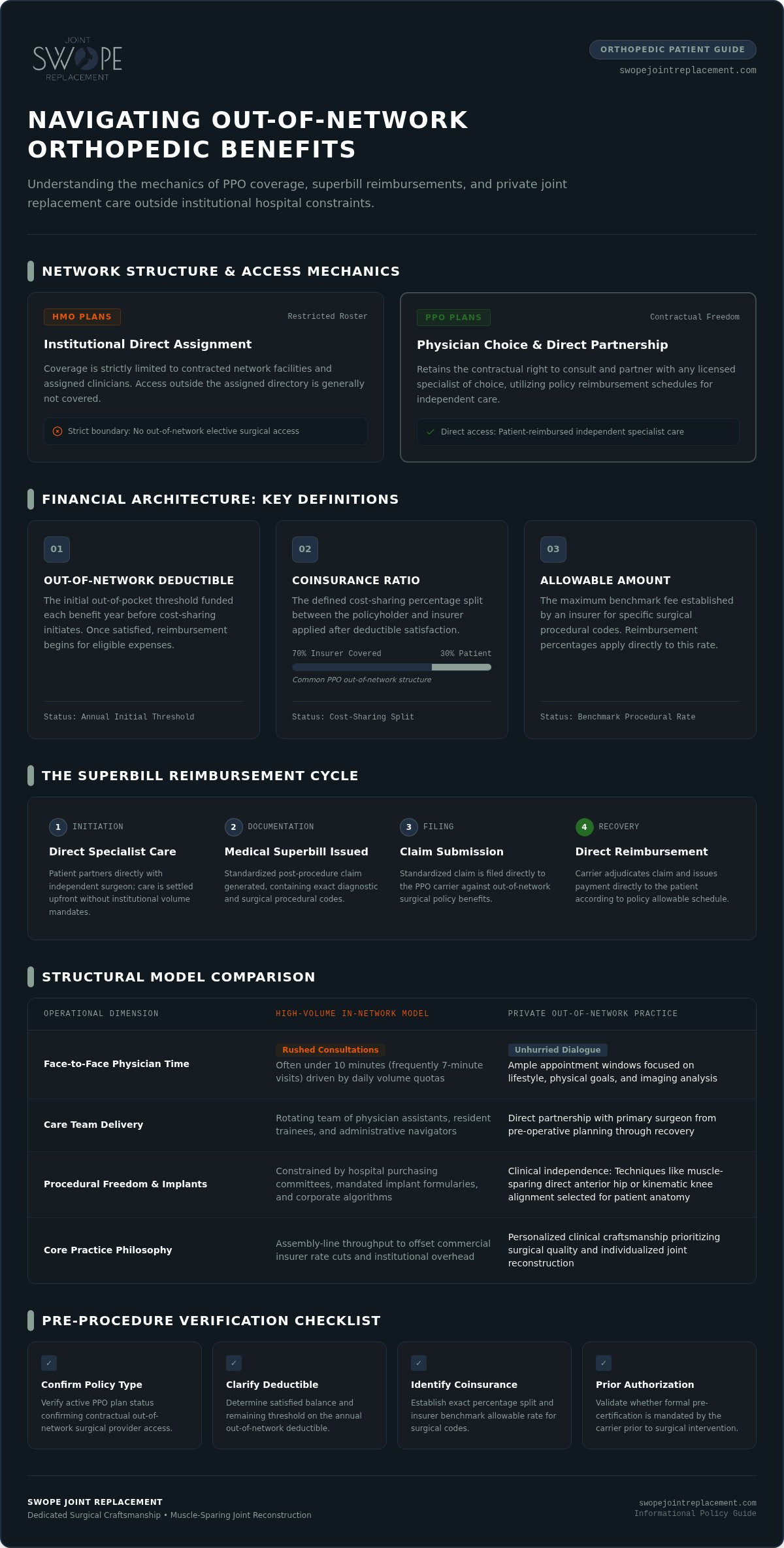
Your plan structure dictates your level of physician access. If you carry a Preferred Provider Organization (PPO) plan, you retain the contractual right to see any licensed physician you choose. In contrast, health maintenance organizations (HMOs) generally restrict coverage strictly to contracted network facilities and assigned clinicians.
PPO coverage for independent surgical care functions through patient reimbursement rather than direct insurer-to-clinic settlement. Instead of a practice adjusting its care standards to match institutional volume demands, you partner directly with your private specialist. You settle your care upfront and submit standardized claims to your insurer, collecting benefits directly according to your policy's out-of-network schedule.
Essential Terminology: Deductibles, Coinsurance, and Allowable Amounts
Evaluating your surgical coverage requires clarity on three foundational concepts:
Out-of-Network Deductible: The initial threshold you fund out of pocket each benefit year before your insurer initiates cost-sharing. Once met, your policy begins reimbursing eligible medical expenses.
Coinsurance: The defined percentage split between you and your insurer after satisfying your deductible. A common structure is an 70/30 split, where the carrier reimburses 70% of covered charges.
Allowable Amount: The maximum benchmark fee your insurer assigns to specific surgical procedural codes. Your reimbursement percentage applies directly to this established rate rather than the total billed fee.
Mastering these terms removes ambiguity. It allows you to examine your orthopedic surgeon out of network benefits with confidence, ensuring you protect both your physical recovery and your financial peace of mind.
In-Network Constraints vs. Private Out-of-Network Orthopedic Care
Large hospital systems rarely discuss the operational compromises behind their in-network status. When commercial insurers cut physician reimbursement rates, institutional systems compensate by accelerating patient turnover. This economic reality turns clinical evaluations into hurried checkpoints. By leveraging your orthopedic surgeon out of network benefits, you step outside this high-volume treadmill and regain control over who reconstructs your joint.
The Structural Pressures of High-Volume In-Network Orthopedics
Institutional contracts force network clinics to schedule dozens of consultations daily to cover corporate overhead. Face-to-face physician time frequently drops to under ten minutes. Instead of speaking with your actual surgeon, you often encounter a rotating team of physician assistants, resident trainees, and administrative navigators.
Hospital purchasing committees and restrictive insurer algorithms also dictate procedural options. Network doctors frequently face strict implant formularies and mandated surgical pathways. Even while federal regulations safeguard your rights against surprise medical bills in emergency hospital settings, elective joint procedures within network systems still subject patients to institutional constraints and fragmented care.
The Concierge Orthopedic Advantage: Direct Access and Autonomy
Independent surgical practices operate under an entirely different philosophy. By declining restrictive managed-care panels, an independent specialist protects extended, unhurried appointments. Your consultation focuses on your lifestyle, physical objectives, and imaging analysis:
Direct Surgeon Communication: You partner directly with your primary surgeon from pre-operative planning through recovery, eliminating miscommunications with intermediaries.
Clinical Independence: Surgical approaches, such as muscle-sparing direct anterior hip replacement or kinematic knee alignment, are chosen purely for your anatomy rather than hospital supply contracts.
Unhurried Dialogue: Ample appointment windows ensure every question receives a thoughtful, detailed answer without looking at the clock.
Utilizing your orthopedic surgeon out of network benefits transforms joint care from an impersonal corporate encounter into an attentive partnership. If you value dedicated craftsmanship and direct access, considering private orthopedic surgery provides a proven path back to comfortable mobility.
How Surgical Reimbursement and Superbills Function in Practice
Insurance paperwork often feels intentionally opaque. When you step outside institutional networks, however, financial transactions become straightforward and transparent. Instead of receiving confusing hospital statements months down the road, you partner directly with your physician. Utilizing your orthopedic surgeon out of network benefits relies on a clean, standardized reimbursement workflow that leaves you fully in control of your claims.
Deconstructing the Medical Superbill for Joint Replacement
The foundation of out-of-network reimbursement is the medical superbill. This itemized document serves as the formal financial invoice you provide to your insurance carrier. Rather than an unformatted receipt, it details precise clinical data examiners require to adjudicate claims promptly. Understanding how a superbill works helps demystify the submission process.
Every proper surgical superbill contains specific components:
ICD-10 Diagnostic Codes: Exact clinical identifiers documenting joint osteoarthritis, mechanical loosening, or cartilage degeneration.
CPT Procedural Descriptors: Standardized procedural codes identifying total joint reconstruction, surgical exposure, and operative components.
Provider Credentials: The surgeon's National Provider Identifier (NPI), tax identification, and facility location credentials.
You pay the practice fee directly at the time of service, receive this finalized documentation, and submit it electronically or by mail. Your insurer processes the claim and delivers reimbursement checks directly to you based on your policy terms.
Navigating Prior Authorization and Gap Exceptions
Elective joint reconstruction requires careful administrative preparation. Securing formal pre-authorization before your operative date establishes medical necessity within your carrier's database. Because CMS rules effective January 1, 2026, shortened standard prior authorization review timelines to seven calendar days for commercial and Medicare Advantage payers, decisions now move substantially faster than in past years.
Complex surgical situations sometimes warrant an administrative request known as a network gap exception. If an in-network facility lacks a specialist trained in specific advanced techniques, your carrier may agree to cover out-of-network surgical care under preferred in-network terms. A dedicated private practice assists this process by equipping you with comprehensive clinical notes, objective mobility assessments, and operative planning records.
Exercising your orthopedic surgeon out of network benefits replaces institutional billing chaos with predictable documentation. You know exactly what services were performed, how they were coded, and where your reimbursement stands at every phase.
Verifying Your Out-of-Network Benefits: Step-by-Step Checklist
Taking charge of your surgical journey starts with a focused phone call to the Member Services number on the back of your insurance card. Insurance representatives rarely volunteer policy nuances unprompted. Asking targeted, informed questions reveals the precise scope of your orthopedic surgeon out of network benefits and protects your household budget.
Essential Questions to Ask Your Insurance Representative
Arm yourself with a dedicated notepad, your member ID, and this practical inquiry script before dialing:
Benefit Verification: "Does my current policy maintain active out-of-network benefits for elective outpatient and inpatient orthopaedic surgery?"
Allowable Percentages: "What exact percentage of allowable charges does my plan reimburse for non-contracted surgical providers once my deductible is satisfied?"
Current Balances: "What is my remaining individual out-of-network deductible for this benefit year, and what is my total out-of-pocket maximum?"
Pre-Authorization Criteria: "Which specific CPT procedure codes require formal prior authorization, and where can my surgeon's office fax the clinical documentation?"
Submission Standards: "What exact documentation must accompany my member claim form to ensure processing without administrative delays?"
Always request a reference number for the call and ask for written confirmation of your benefits via email or portal mail.
Evaluating Out-of-Pocket Maximums and Budgeting Safety
Your policy's out-of-pocket maximum serves as an essential financial backstop. This threshold caps your total financial contribution toward covered services during a single calendar benefit year. Once you satisfy this limit, your carrier reimburses eligible covered care at full allowable rates for the remainder of that year.
Understanding this threshold allows for strategic calendar scheduling. Undergoing hip or knee reconstruction earlier in your plan year means subsequent postoperative care, prescribed rehabilitation, and clinical evaluations often qualify for complete allowable reimbursement. You eliminate guesswork and proceed into surgery with absolute clarity.
When you verify your orthopedic surgeon out of network benefits early, you reclaim authority over your surgical treatment. To review your coverage questions and plan your care with an attentive specialist, schedule a consultation with Swope Joint Replacement.
Partnering with an Independent Joint Replacement Specialist
Selecting an independent surgeon aligns your joint restoration with dedicated clinical craftsmanship and undivided attention. When institutional quotas no longer dictate appointment lengths, your personal recovery becomes the primary benchmark of success. Exploring your orthopedic surgeon out of network benefits gives you direct access to specialized reconstructive expertise without corporate friction.
Bespoke Joint Reconstruction: Hip, Knee, and Revision Care
Swope Joint Replacement is a veteran-owned private orthopaedic surgery practice founded and led directly by Dr. Ryan Swope. Serving the greater Kansas City metropolitan area, the practice delivers direct physician access at every stage. You consult directly with your operating surgeon rather than navigating mid-level clinical intermediaries.
Dr. Swope focuses on advanced reconstructive techniques tailored to each patient's unique biomechanics. For individuals experiencing degenerative hip pain, explore our comprehensive guide to Direct Anterior Hip Replacement in Overland Park to discover how muscle-sparing approaches preserve soft tissue. Whether you require a primary total knee replacement or a complex revision procedure to resolve a compromised implant, your care plan is built around unhurried evaluations and precise execution.
Taking the Next Step Toward Your Orthopedic Consultation
Preparing for a private surgical consultation is straightforward and organized. Preparing ahead ensures your initial visit focuses entirely on clinical solutions:
Compile Records: Gather recent diagnostic imaging discs, operative reports from prior surgeries, and relevant laboratory results.
Verify Coverage: Confirm your out-of-network deductible, coinsurance rates, and submission guidelines using the checklist outlined above.
Review Reimbursement Options: Discuss transparent out-of-network billing workflows and direct cash pricing options directly with our team.
Following your evaluation or surgical care, our office provides itemized, fully coded superbills to make filing claims with your PPO insurer as smooth as possible. Utilizing your orthopedic surgeon out of network benefits allows you to choose an experienced joint specialist who values your time, respects your mobility goals, and remains by your side through every step of recovery.
Reclaim Control Over Your Joint Health
Your mobility shapes your daily quality of life. Settling for rushed appointments or an assigned physician simply because of an insurance directory can compromise your surgical journey. Leveraging your orthopedic surgeon out of network benefits allows you to prioritize clinical precision, personal autonomy, and an unhurried doctor-patient relationship.
At Swope Joint Replacement, a veteran-owned private orthopaedic surgery practice led directly by Dr. Ryan Swope, we reject the institutional volume model. You receive direct physician access from your first evaluation through your final recovery milestone, without your care ever being delegated away. We guide you through transparent financial workflows, providing itemized superbills that make submitting claims to your PPO carrier straightforward and predictable.
You have the power to choose excellence for your hip or knee reconstruction. When you're ready for individualized, unhurried surgical expertise, Schedule Your Unhurried Consultation with Dr. Swope and take the first step toward lasting comfort.
Frequently Asked Questions
Can I use health insurance if my orthopedic surgeon is out of network?
Yes, you can use your health insurance if you hold a PPO or POS policy with out-of-network provisions. While HMO plans typically restrict coverage strictly to assigned network facilities, PPO plans allow patients across the Kansas City area to consult independent specialists. You settle care fees directly with the practice and submit standardized documentation to collect direct reimbursement from your insurer based on your policy schedule.
What is the main difference between in-network and out-of-network orthopedic surgery?
The primary difference centers on physician autonomy, appointment time, and direct doctor-patient communication. In-network care requires clinics to manage intense patient volumes under hospital system contracts, frequently compressing visits to brief checkpoints. Choosing private care through orthopedic surgeon out of network benefits allows for extended, unhurried consultations, personalized procedural techniques like muscle-sparing joint reconstruction, and direct physician access without delegating care to mid-level clinical intermediaries.
How does an out-of-network superbill work for joint replacement?
A superbill functions as an itemized, standardized medical document containing the specific diagnostic ICD-10 and procedural CPT codes required for your surgery. Following your joint procedure or clinical evaluation, our office generates this comprehensive invoice. You submit this documentation directly to your PPO insurance carrier. The insurer reviews the clinical coding, calculates your allowable benefit rate, and remits a reimbursement check directly to your home.
Will my insurance reimburse the entire cost of private orthopedic surgery?
No, health insurance carriers rarely reimburse the entire cost of private surgical care. Total reimbursement is determined by your plan's deductible, coinsurance percentage, and customary allowable charge benchmarks. The carrier reimburses their contracted percentage of that allowable fee after your deductible is satisfied. You remain responsible for any difference between the practice fee and what the carrier covers, ensuring complete financial transparency before surgery.
What is an out-of-network deductible and how does it apply to surgery?
An out-of-network deductible is the annual amount you must pay out of pocket before your insurer begins cost-sharing for non-contracted services. This deductible functions separately from your in-network deductible. When scheduling elective joint replacement, major procedural charges rapidly satisfy this initial threshold. Once cleared, your policy's out-of-network coinsurance activates, enabling you to receive percentage-based reimbursement for surgical fees, subsequent evaluations, and recovery care throughout your benefit year.
Can I get a network gap exception for an out-of-network surgeon?
Yes, patients can request a network gap exception if contracted network facilities cannot provide specialized surgical care within a reasonable timeframe or distance. If regional hospital networks lack a specialist performing advanced procedures, such as direct anterior hip replacement or complex joint revision, insurers may approve out-of-network care at in-network rates. Securing an exception requires submitting detailed clinical documentation, which our Overland Park practice provides to establish clear medical necessity.
Why do some elite joint replacement surgeons operate outside insurance networks?
Elite reconstructive surgeons operate independently to preserve clinical craftsmanship and provide unhurried, patient-centered care. Institutional network contracts often impose volume quotas, restrict operating time, and mandate specific hospital vendor implants. By utilizing orthopedic surgeon out of network benefits, patients partner directly with Dr. Swope in the Kansas City area for comprehensive pre-operative planning, muscle-sparing joint reconstruction, and attentive postoperative care unhindered by institutional red tape.


Comments