Joint Injection Therapy in Overland Park: How to Understand Your Options

What if an injection isn’t the first question to answer about your joint pain? When you search “joint injection therapy Overland Park,” you’re likely looking for relief that helps you return to daily activities, without committing to a treatment before you understand your options. Ongoing pain can make familiar tasks difficult, and it’s reasonable to ask what an injection may help with, how an appointment works, and what recovery might involve.
The right next step starts with understanding the cause of your symptoms and what matters most to you. Joint injections may be one part of a personalized non-operative care plan, but they aren’t right for every diagnosis or goal. At Swope Joint Replacement, you can discuss your symptoms and priorities directly with the physician and consider how targeted injections may fit alongside other care options.
This guide explains what joint injections may address, what an evaluation and injection appointment can involve, and how to weigh potential benefits, limitations, risks, and activity afterward. You’ll have a clearer framework for discussing a next step that fits your needs.
Table of Contents
Joint Injection Therapy in Overland Park: Overview
Joint injection therapy is a clinician-directed procedure that delivers treatment to a specific joint or nearby area after an evaluation. Whether it’s appropriate depends on the source of your pain, the joint involved, and your health history. Searching for joint injection therapy in Overland Park may bring up several options, but an injection isn’t a universal first choice or a guaranteed cure. It’s one possible component of care, selected to address an individual diagnosis and goals.
The phrase joint injection covers procedures that place treatment in or around a joint. The exact target matters: discomfort near a joint doesn’t always mean the joint itself is causing it. A careful evaluation helps clarify what may be contributing to your symptoms before a treatment is considered.
Which symptoms and diagnoses may lead to an injection discussion?
Persistent pain, stiffness, or signs of inflammation are reasons to seek an evaluation, particularly when symptoms affect walking, work, sleep, or other daily activities. Osteoarthritis and joint inflammation are examples of issues that may come up in a discussion about injections. Neither diagnosis automatically means an injection is appropriate. The physician considers how symptoms developed, what makes them better or worse, and how they affect your everyday function.
Your history and examination help determine whether the joint is likely to be the pain source. For example, discomfort around a knee may relate to the joint, but it can also involve nearby tissues or another source. Sharing when the pain began, which movements aggravate it, and what you’ve already tried gives the physician useful context. The goal is to understand the problem before weighing a procedure, rather than choosing a treatment based on the location of pain alone.
When might an injection fit into non-operative joint care?
An injection may be considered alongside other non-operative approaches, such as medication management and rehabilitation planning. These options aren’t necessarily alternatives to one another. Depending on the diagnosis and your needs, a plan may combine approaches or focus on a different step first. The choice depends on your health history, the affected joint, and what you hope to do with less difficulty.
It helps to frame the conversation around practical goals. Are you hoping to manage pain during a particular activity, move more comfortably, or take part in a rehabilitation plan? Your priorities can guide a discussion of whether an injection makes sense, what it may and may not address, and what other approaches could be considered. The plan should reflect your diagnosis and circumstances, not a one-size-fits-all sequence.
For a broader look at nonsurgical approaches, the guide Non-Operative Joint Care in Kansas City: A Guide to Nonsurgical Options explores how different forms of care may fit together. An individualized discussion can help you understand where injections belong, if at all, in your care plan.
How Joint Injections Work: Matching the Treatment to the Diagnosis
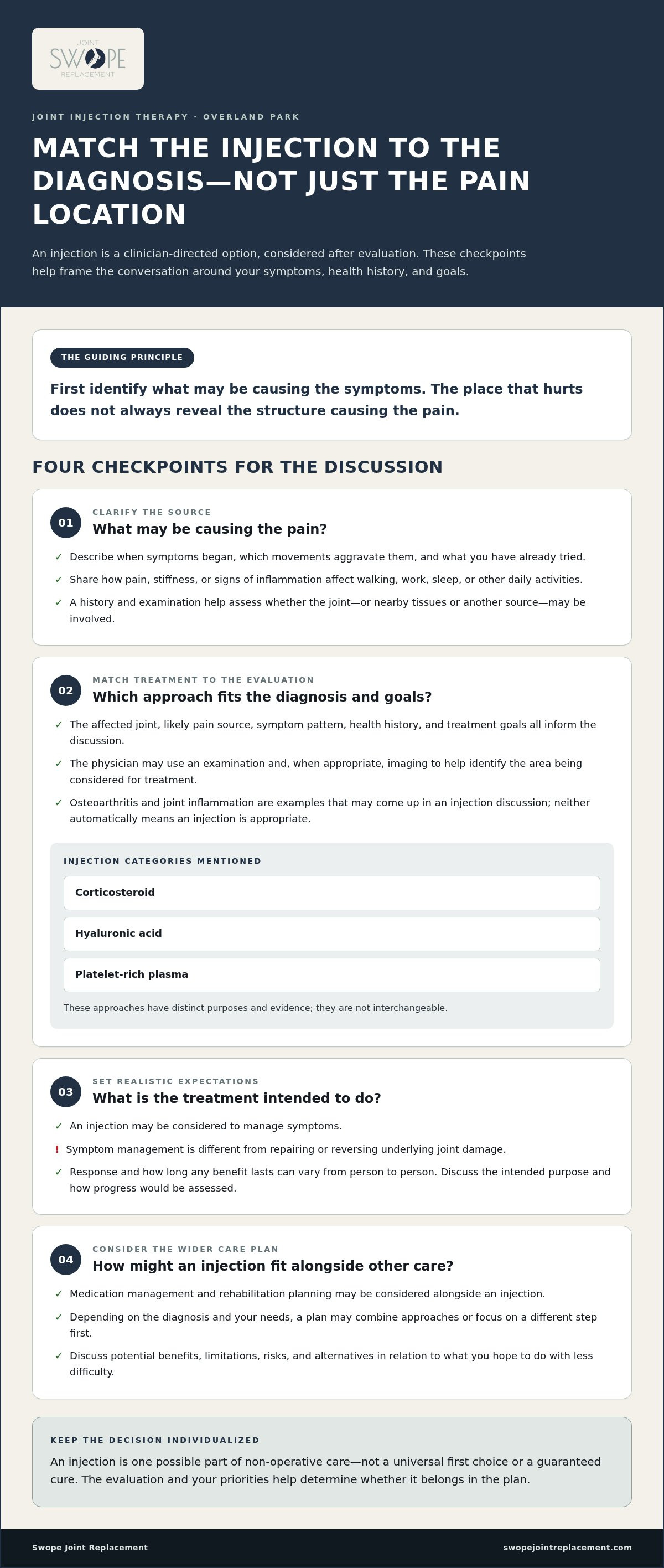
A joint injection places a selected treatment into a joint or a nearby structure. The target and approach depend on what the evaluation suggests is causing your symptoms. The physician may use the physical examination and, when appropriate, imaging to guide the decision and identify the area being treated. The goal is not simply to inject where it hurts, but to match a potential treatment to a specific clinical reason.
Diagnosis should guide injection selection because the likely pain source, affected joint, symptom pattern, health history, and treatment goals all influence which approach may be appropriate and what benefits and risks to discuss. The same procedure isn’t automatically suitable for everyone with joint pain. If you’re exploring joint injection therapy in Overland Park, focus first on how the problem has been identified and how an injection might fit your goals.
How clinicians decide which injection approach to discuss
Your symptoms, examination, and relevant medical history help shape the discussion. Imaging may add useful information when clinically appropriate, but it’s considered alongside how you feel and function. Different substances and procedures have distinct purposes and evidence. General categories include corticosteroid, hyaluronic acid, and platelet-rich plasma injections. These categories are not interchangeable, and whether a particular approach makes sense depends on the diagnosis and your care plan.
For example, when considering pain around a knee, the physician first assesses whether the joint itself is the likely source and what condition may be contributing. The location of discomfort alone doesn’t determine the treatment. The American College of Rheumatology’s overview of Joint Injections describes common reasons for injections, medication categories, and potential risks. Use that general information as background, then discuss how it applies to your health and diagnosis with your physician.
What injections can and cannot be expected to do
An injection may be considered to manage symptoms, but symptom management is different from repairing or reversing underlying joint damage. The response and how long any benefit lasts can vary from person to person, so don’t assume a specific result or timeline. Your physician can explain the intended purpose of a proposed treatment and what signs would help assess whether it’s meeting your goals.
An injection also doesn’t automatically replace rehabilitation, medication management, or other recommended care. Depending on your diagnosis and circumstances, it may be considered alongside those approaches or not selected at all. Ask how the treatment fits into the broader plan, what alternatives are reasonable, and what risks matter given your health history. In a personalized non-operative plan, those answers should connect the clinical reasoning to what you want to do more comfortably.
At Swope Joint Replacement in Overland Park, you can discuss your symptoms, diagnosis, and functional goals directly with the physician as part of individualized non-operative care.
Joint Injections Compared With Other Non-Surgical Options
An injection is one possible tool, not a required step before other care and not a decision to have surgery. It also shouldn’t be viewed as a permanent fix. Compare each option by how it relates to your diagnosis, daily limitations, and goals. In a clinician-directed plan, approaches may complement one another rather than compete.
How injections differ from medication and rehabilitation
An injection targets a specific joint or nearby structure, while medication may be taken or applied in a different way depending on the treatment. Activity modification changes the demands placed on the joint, and rehabilitation planning focuses on movement and function. These approaches can serve different roles in the same plan. None is automatically safer, faster, or more effective for everyone; the choice depends on your circumstances and clinical evaluation.
The guide Non-Operative Joint Care in Kansas City: A Guide to Nonsurgical Options offers more context on how conservative approaches may fit together. If you’re considering joint injection therapy in Overland Park, use this comparison as a starting point for a diagnosis-focused discussion, not as a ranking of treatments.
Questions to weigh when deciding whether to consider an injection
Before deciding, make sure the conversation connects the proposed treatment to your needs. Describe what you’ve tried, what changed, and which activities remain difficult. Your health history matters too. Ask the physician to explain the intended purpose, possible risks, alternatives, and how the injection would relate to any other recommended care. Your informed preferences belong in that decision.
What diagnosis or suspected pain source would the injection address?
Which daily activities are limited, and what change would matter most to you?
How have previous treatments affected your symptoms or function?
Do your health history or current medications raise considerations to discuss?
How might medication, activity adjustments, or rehabilitation fit alongside the proposed approach?
Swope Joint Replacement’s personalized non-operative care can include targeted injections, medication management, and rehabilitation planning.
What to Expect at a Joint Injection Appointment in Overland Park
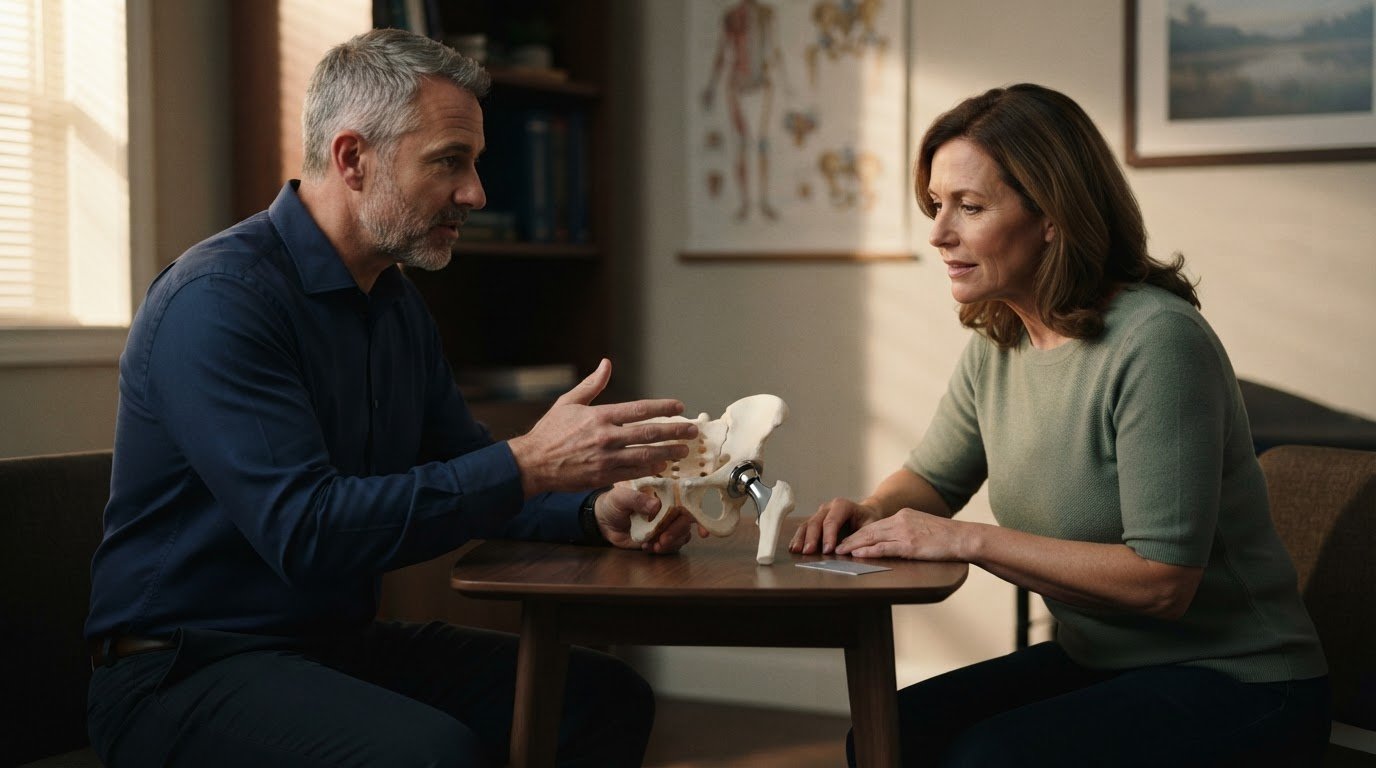
A thoughtful appointment is a conversation before it’s a procedure. If you’re considering joint injection therapy in Overland Park, you should understand why an injection is being discussed, what it may address, and what other choices are available. The visit follows a clear sequence, with your questions and preferences part of the decision.
Discuss your symptoms. Describe where discomfort occurs, when it began, what affects it, and how it changes your daily activities.
Review relevant history. Share health conditions, medications, allergies, previous treatments, and relevant records.
Examine the joint. The physician assesses the area and considers whether your symptoms and examination point to the joint as a likely source.
Consider options together. If an injection is being considered, discuss its purpose, potential benefits and risks, alternatives, and what to expect before giving consent.
The precise procedure depends on the joint and treatment being considered. In general, the physician prepares the area and delivers the selected treatment to the intended location. Details can vary, so don’t assume every injection uses the same technique or requires the same preparation. You should have a chance to ask questions and understand the plan before treatment begins.
How to prepare for the visit
A little preparation can help you use the appointment well. Bring a current medication list and relevant records, and note a concise timeline of your symptoms. Think about which activities have become difficult, such as walking, climbing stairs, or completing tasks at work, and what you hope to regain. Ask the care team about any preparation instructions for the planned procedure.
What to discuss before and after the procedure
Before treatment, ask why this approach is being considered for your diagnosis, what benefits may be realistic, what side effects or risks apply to you, and what alternatives you could choose. Your medical history and preferences matter. Consent should follow a clear discussion, not an assumption that an injection is the only next step.
Afterward, follow the physician’s individualized guidance. Activity recommendations may vary with the joint, procedure, and your health factors, so don’t assume you can return immediately to your usual routine. Ask what to monitor, how follow-up will work, and whom to contact with concerns. New or worsening symptoms after treatment deserve medical attention; seek guidance from your care team about what to do.
In Overland Park, Swope Joint Replacement’s non-operative care can include targeted injections, medication management, and personalized rehabilitation planning. The physician can discuss your joint pain and care options directly with you, based on your symptoms and goals.
A Personalized Joint Injection Plan With Swope Joint Replacement
Joint injection therapy in Overland Park should begin with your diagnosis and priorities, not an assumption that an injection is the right answer. At Swope Joint Replacement, non-operative care can include targeted injections, medication management, and personalized rehabilitation planning. These approaches may be considered as part of a broader plan shaped around your symptoms, health history, and the activities you want to do more comfortably.
How a physician-led evaluation supports an individualized plan
Direct physician access gives you the opportunity to discuss your concerns with the physician, including where symptoms occur, what makes them worse, and how they limit your routine. That conversation, together with an evaluation, helps connect your symptoms to a diagnosis and your functional goals. For one person, a priority might be walking with less difficulty; for another, it could be managing discomfort during work or daily tasks.
An injection is considered within the wider non-operative plan when appropriate. It isn’t automatic, and no particular result can be promised. The physician can explain the reasoning behind an option, how it relates to your diagnosis, and how medication management or rehabilitation planning may fit alongside it. You can weigh the potential benefits, limitations, and alternatives before deciding on a next step.
Practical next steps for Overland Park and Kansas City patients
To make your consultation more useful, gather relevant medical records and a current medication list. A short timeline of your symptoms can help clarify how the problem has changed. Note which movements or activities are difficult and what you’d most like to regain. Bring your questions, including what the evaluation suggests, which care options fit your situation, and how progress will be discussed.
For patients in Overland Park and the greater Kansas City area, including Olathe, Lees Summit, Lenexa, Leawood, Blue Springs, and Independence, Swope Joint Replacement follows a concierge care model with direct physician access. The practice operates outside in-network insurance arrangements and offers transparent cash pricing and out-of-network options, so you can understand the payment model as you consider care.
If you’re comparing care models, the guide Concierge Orthopaedic Surgeon in Overland Park: How to Choose can help you think through what matters in a physician relationship, including communication and individualized attention. Your joint-care plan should leave room for your questions and reflect your priorities.
If ongoing joint pain is limiting your daily life, an individualized non-operative evaluation can help clarify a next step.
Take the Next Step at Your Own Pace
You don’t have to arrive with a decision already made. A useful next step can simply be clarifying what’s behind your joint pain and which outcomes matter most to you. From there, you can weigh whether an injection belongs in your care plan, consider other approaches, and decide what feels right with a clearer understanding of the tradeoffs.
If you’re exploring joint injection therapy in Overland Park, let your questions lead the conversation. Ask what the evaluation suggests, how each option relates to your priorities, and what you’d want to know before choosing a treatment. The goal isn’t to pursue a procedure for its own sake. It’s to make a considered choice that supports your health and daily life.
Discuss your joint-care options with Swope Joint Replacement and take a thoughtful next step toward care that reflects your needs.
Frequently Asked Questions
Are joint injections effective for arthritis pain?
Joint injections may ease arthritis symptoms for some people, but the response depends on the diagnosis, injection approach, and individual health factors. They don’t reverse arthritis or work equally well for everyone. An injection may be considered to address symptoms that interfere with a particular activity, while another care approach may better fit a different situation. Ask your physician what improvement is realistic for your case and how it will be assessed.
How long can relief from a joint injection last?
There’s no single timeline that applies to every joint injection. The type of treatment, the condition being addressed, and your individual response can all influence whether symptoms change and for how long. Your physician can explain what is known about the proposed approach and what to monitor afterward. Consider tracking specific activities, such as walking or using stairs, so you can describe any changes at follow-up.
Can a joint injection delay or prevent surgery?
A joint injection may help manage symptoms, but it can’t be relied on to delay or prevent surgery. Whether surgery is appropriate depends on the joint condition, its effect on your life, and your overall health, not on an injection alone. If surgery has been discussed, ask how non-operative care fits into your options and what changes would warrant revisiting that conversation. Choosing an injection doesn’t commit you to surgery later.
What are the possible risks or side effects of a joint injection?
Possible risks vary with the injection and your health history. They may include temporary soreness or a short-term increase in discomfort; less common but more serious concerns can include infection, bleeding, or a reaction to the medication. Share allergies, medical conditions, and medicines with your physician before treatment. Ask which side effects are relevant to the specific approach being considered and what symptoms should prompt you to seek medical advice.
Can I drive myself home after a joint injection?
Whether you can drive depends on the joint treated, the medication used, and how you feel afterward, so there isn’t a universal answer. Ask the care team before your visit whether you should arrange a ride. Don’t drive if you feel impaired or have numbness, weakness, or difficulty controlling the treated limb. For example, symptoms affecting your leg could make operating pedals difficult even if you otherwise feel well.
How soon can I return to normal activities after an injection?
Your return to usual activities depends on the procedure, the joint, and your personal health factors. Follow the activity guidance provided for your specific treatment rather than relying on someone else’s recovery experience. Ask whether you should adjust exercise, work duties, or other physical demands, and what signs mean you’re ready to increase activity. If discomfort affects a planned task, pause and seek guidance rather than pushing through it.
Does insurance cover joint injection therapy in Overland Park?
Coverage varies by insurance plan and the treatment being considered. Swope Joint Replacement operates outside in-network insurance arrangements, offers out-of-network insurance options, and provides transparent cash pricing. The practice doesn’t provide in-network billing. Review your benefits and clarify how your plan handles out-of-network care so you understand potential costs. Swope serves patients in Overland Park and the greater Kansas City area, including Olathe, Lees Summit, Lenexa, Leawood, Blue Springs, and Independence.
When should I seek medical attention after a joint injection?
Seek prompt medical advice for new or worsening symptoms, especially increasing pain, warmth, redness, swelling, drainage, or fever after an injection. These signs need assessment rather than guesswork. If you develop severe symptoms or signs of a serious allergic reaction, such as trouble breathing or swelling of the face or throat, seek emergency care. Follow any specific instructions you received and tell the clinician when the injection was performed.

Comments