Knee pain in Olathe: when to seek care and relief options

Knee pain that lasts longer than a week or two is a reason to seek an evaluation. Managing knee pain without surgery in Olathe may involve injections, a brace, targeted exercises, or low-impact activities, depending on the cause and how pain affects your movement.
Pain can make ordinary steps feel like a bigger decision. The knee absorbs about 1.5 to 2 times your body weight when you walk on level ground, and the load can rise to 4 to 5 times your body weight on stairs or with deep bending. Understanding how the joint is being stressed can help make sense of why certain activities hurt and which adjustments may help.
Learn when knee pain needs medical attention and how nonsurgical options may ease symptoms and support mobility. This overview covers common causes, injections, braces and other assistive devices, range-of-motion exercises, and low-impact activities such as walking, swimming, or cycling.
Table of Contents
1. When should I see a doctor for knee pain?
Arrange a medical evaluation if knee pain lasts longer than a week or two. A clinician can assess your symptoms, movement, and daily limitations, then tailor treatment to the likely cause. Pain that interferes with walking, for instance, may call for a different plan than discomfort that mainly occurs on stairs.
Physical therapy is one nonsurgical option for knee pain, including pain related to arthritis. A therapist can tailor exercises to strengthen the muscles around your knee and improve support. Exercises may focus on the quadriceps, hips, and glutes, which help stabilize the joint when you stand, walk, or rise from a chair.
How do nonsurgical treatments compare with surgery for osteoarthritis? Nonsurgical care aims to ease symptoms and support movement through options such as exercise, medication, or injections. Surgery is a different approach. An evaluation can help clarify how your symptoms, mobility, and knee condition factor into that decision.
What nonsurgical treatments help manage knee pain? Options include physical therapy, strengthening exercises, low-impact activity, assistive devices, and medication or injections. A personalized plan matches these approaches to your pain and the activities you want to continue.
For managing knee pain without surgery in Olathe, physical therapy can combine targeted strengthening with movement practice. A therapist may work on bending and straightening your knee, then build strength for everyday tasks such as walking or rising from a chair. Low-impact exercise can complement this work without repeated high-impact movements.
What exercises and physical therapy help knee pain? A customized program may include range-of-motion exercises and strengthening for the muscles around your knee, hips, and glutes. Walking, swimming, and cycling are low-impact activities that can support joint function while limiting stress on the knee.
How much does physical therapy for knee pain cost in Olathe, Kansas? The cost depends on the treatment plan, visits, and insurance benefits; the amount you pay depends on your coverage and billed services. Does insurance cover knee physical therapy, imaging, or injections in Kansas? Coverage varies by insurance plan and by service, so physical therapy, imaging, and injections may have different benefits and out-of-pocket costs.
Which Olathe clinics offer nonsurgical knee pain treatment? Orthopaedic practices and physical therapy clinics are common settings for evaluation and nonsurgical care. An orthopaedic evaluation can connect your symptoms with a treatment plan, while physical therapy focuses on movement, strength, and function.
2. Corticosteroid injections
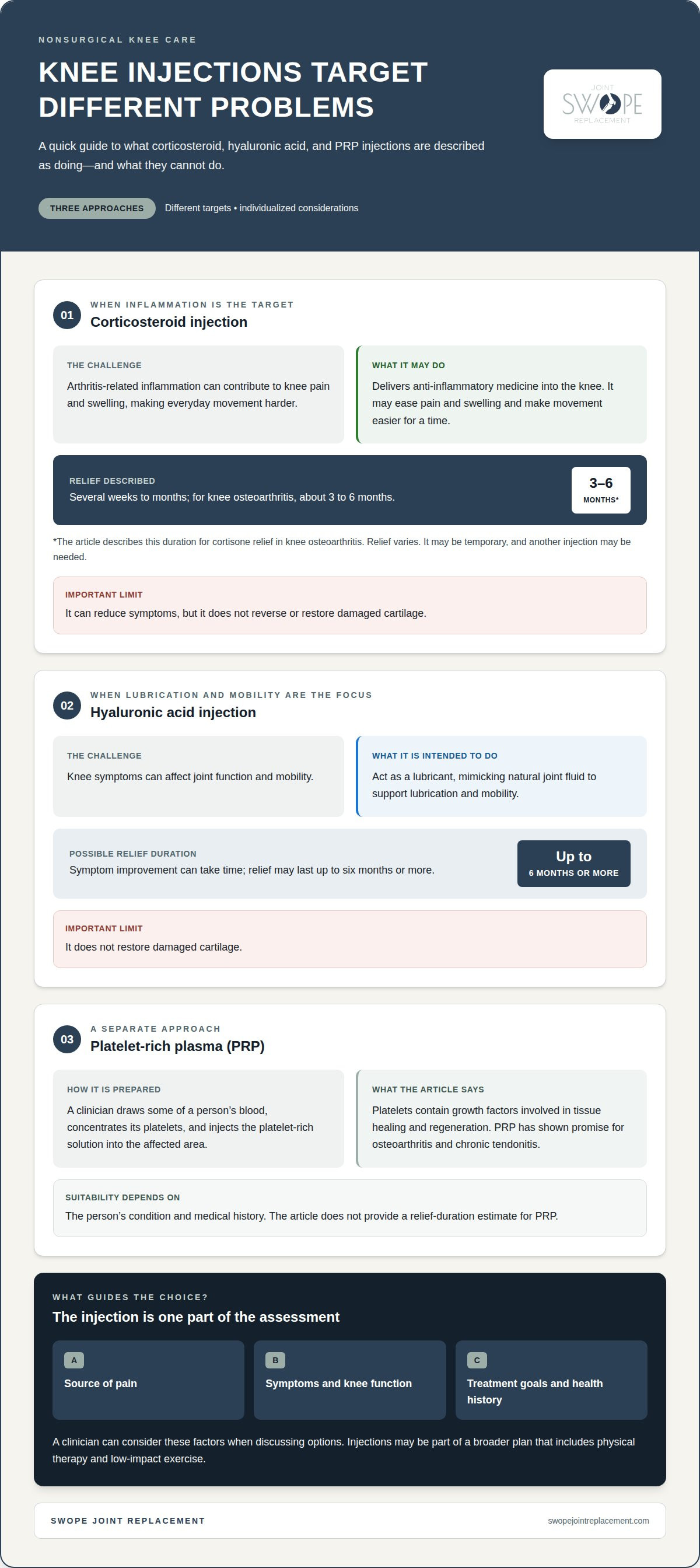
A corticosteroid injection, often called a steroid shot, delivers anti-inflammatory medicine into the knee. For arthritis, it may reduce inflammation, pain, and swelling, making everyday movement easier for a time. Its aim is symptom relief, not repair of underlying joint damage.
Relief varies in duration. Steroid injections for knee pain may help for several weeks to months. For knee osteoarthritis, cortisone relief is described as lasting about 3 to 6 months before another injection may be needed. Cortisone doesn’t reverse or restore damaged cartilage, so it isn’t a cure for osteoarthritis.
Hyaluronic acid injections work differently. Hyaluronic acid acts as a lubricant in the knee and may support joint function. The injection is intended to improve lubrication and mobility by mimicking natural joint fluid. Symptom improvement can take time, and relief may last up to six months or more.
These injections serve different purposes. A steroid injection targets inflammation and may provide relatively quick relief, while hyaluronic acid focuses on joint lubrication. Neither restores damaged cartilage. Injections may form part of a broader plan that includes physical therapy, low-impact exercise, or weight management to reduce knee strain.
What medications and injections are used for knee pain, and what are their risks? Options include anti-inflammatory medicines such as ibuprofen or naproxen, acetaminophen, corticosteroid injections, hyaluronic acid injections, and platelet-rich plasma (PRP). Risks depend on the medicine, your health history, and other medicines you take. A doctor can consider these details when discussing treatment.
PRP injections use a different approach. A clinician draws some of your blood, concentrates its platelets, and injects the platelet-rich solution into the affected area. Platelets contain growth factors involved in tissue healing and regeneration. PRP has shown promise for osteoarthritis and chronic tendonitis, but suitability depends on your condition and medical history.
Choosing among injections depends on the source of pain, your symptoms, and treatment goals. A doctor considers your diagnosis, knee function, and health history when discussing options. Injections may help manage symptoms, but they don’t replace an evaluation of persistent pain or determine on their own whether surgery is appropriate.
For individualized nonsurgical knee care, an evaluation can help connect your symptoms with appropriate treatment options, including injections when they fit your needs.
Steroid shots are one possible way to relieve arthritis symptoms, alongside physical therapy. Corticosteroid injections can provide short-term relief for knee arthritis and may quickly reduce pain and swelling. The benefits can be temporary, and repeat treatments may be needed.
PRP injections use platelets from a person's own blood to support tissue regeneration, wound healing, and cartilage repair. A healthcare professional should assess whether PRP therapy is suitable for the individual’s condition and medical history.
3. Assistive devices and knee braces
A brace, sleeve, cane, or shoe insert can change how force reaches your knee during daily movement. These devices may reduce joint pressure, ease discomfort, and support mobility. The right choice depends on your symptoms, joint condition, and the activity that causes difficulty, such as walking or standing.
Knee sleeves and braces provide external support around the joint. A sleeve may help stabilize the knee and reduce strain, while a brace may also help align the joint. Support for alignment may reduce friction between bones. These devices don’t address every cause of pain, so match their purpose to the problem.
An unloader knee brace is designed for osteoarthritis affecting one side of the knee. It shifts force toward the less-affected side, reducing pressure on the more affected area. Someone with arthritis concentrated on one side, for example, may be considered for this brace. It is designed for that specific pattern, not every painful knee.
Functional braces serve a different purpose from unloader braces. They can provide support after an injury, while unloader braces are used for knee osteoarthritis. The distinction matters: symptoms following an injury may call for different support than arthritis-related discomfort. A brace should fit the diagnosis and the movements you need to manage.
A cane or walker can offer another way to reduce strain. By shifting the body's center of gravity away from the affected side, either device may reduce stress on the knee. For someone whose knee hurts while walking, an assistive device may be useful alongside other treatment. Shoe inserts can also help relieve joint pressure and support mobility.
Choosing a device is part of treatment, not a one-size-fits-all purchase. A physical therapist or orthopaedic specialist can match it to your joint condition, symptoms, and mobility needs. An assessment may distinguish between support after an injury and pressure relief for one-sided osteoarthritis, helping guide the choice.
Braces and walking aids work best as practical supports for specific activities. A brace may help with joint stability during movement, while a cane can reduce loading on the affected side when walking. Physical therapy can address strength and movement as an assistive device helps manage pressure. These devices don’t reverse cartilage damage or remove the need to understand the underlying cause.
For managing knee pain without surgery in Olathe, discuss how a brace, sleeve, cane, or insert fits your diagnosis and daily routine. A well-matched device supports movement and addresses a specific need, such as stability after an injury or reduced pressure with osteoarthritis.
4. Range-of-motion exercises and low-impact activities
Movement can help maintain knee function without the repeated impact of running. For knee osteoarthritis, low-impact aerobic sessions usually last 20-30 minutes, 3-4 times a week. Walking, swimming, and cycling are examples that can build activity into a routine while placing less strain on the knees. Choose an activity that fits your mobility and current fitness level.
Range-of-motion exercises focus on how far your knee can comfortably bend and straighten. Physical therapy may combine this practice with strengthening for the quadriceps, hips, and glutes. These muscle groups help stabilize the knee during activities such as walking or standing. A therapist can tailor the plan to your symptoms, mobility, and fitness level.
Stretching and strengthening serve different purposes in an exercise plan. Targeted stretching works on flexibility, while strengthening builds support around the joint. Physical therapy can combine both to improve flexibility, support the knee, and ease discomfort. For example, a plan may pair knee movement exercises with strengthening for the quadriceps and hip muscles.
Low-impact exercise can replace activities that place greater stress on the knee. Swimming and cycling offer aerobic movement without the same strain as high-impact activity. Walking, particularly on a level surface, is another option. If running worsens your symptoms, switching to a lower-impact activity may reduce joint stress while keeping you active.
Weight management is another way to ease knee strain. Managing weight can reduce pressure on the knees and may help ease osteoarthritis pain. It works alongside movement, not in place of exercises that improve strength and flexibility. A plan can account for your mobility, preferred activities, and movements that cause discomfort.
Good posture can also reduce unnecessary pressure on your knees during everyday movement. A physical therapist can relate posture, range of motion, and muscle strength to tasks that matter to you, such as walking or cycling. A useful plan provides specific exercises and activities rather than a generic routine. The aim is to support mobility and make regular movement more manageable, especially when chronic symptoms limit your usual activities.
Consistency matters more than choosing the most demanding exercise. Use the 20-30-minute session range and 3-4-times-a-week schedule as general guidance for low-impact aerobic activity with knee osteoarthritis. Physical therapy can refine the activities and targeted exercises around your joint symptoms and fitness level, helping you build a sustainable routine.
5. Knee joint structure and causes of pain
Your knee joint supports your body as it bends, straightens, and bears weight. During level walking, each knee absorbs about 1.5 to 2 times your body weight. Stairs and deep bending can raise that load to 4 to 5 times your body weight. That helps explain why pain may feel different during a level walk than while climbing stairs.
Knee osteoarthritis is a common cause of knee pain, particularly after age 50. It can also appear in a person’s 40s when a prior knee injury or significant genetic predisposition is present. Age offers context, but it doesn’t identify the cause on its own. A painful knee needs an assessment that connects symptoms with your history and movement.
Arthritis is not the only possible cause of knee pain. An injury can also cause pain, and its symptoms may differ from discomfort that builds during everyday activities. Note which movements bring on pain, such as walking on level ground, bending deeply, or using stairs. These details can help a clinician evaluate your knee.
The force on your knee varies throughout the day. Walking on flat ground places a different demand on the joint than climbing or descending stairs. If stairs consistently worsen your symptoms, share that pattern during an evaluation. It doesn’t establish a diagnosis by itself, but it helps explain how certain movements affect your function.
The muscles around your knee contribute to movement and support. Physical therapy can use a customized exercise program to strengthen them. Depending on the cause of pain and its effect on daily activities, a plan may combine movement exercises with other non-operative approaches. The goal is to address symptoms and the movements you want to manage.
Relief options should fit the problem being treated. Medications may offer temporary pain relief, while injections and assistive devices address different symptoms or support needs. Physical therapy focuses on strength, flexibility, and movement. These approaches serve different purposes, so understanding whether pain relates to osteoarthritis, injury, or another cause helps shape a more focused plan.
One in four adults experiences chronic knee pain associated with arthritis. If your knee pain continues to affect walking, stairs, or bending, bring those specific examples to an orthopaedic evaluation. To discuss your symptoms and non-operative knee treatment options, arrange a personalized assessment.
Swope Joint Replacement: Knee Replacement
Swope Joint Replacement provides knee replacement for people whose knee pain continues to limit daily activities despite nonsurgical care. If exercise, medication, injections, or supportive devices haven’t provided enough relief, an orthopaedic evaluation can help determine whether replacement fits your needs. The discussion considers your symptoms, knee function, treatment goals, and the options you’ve tried. Surgery is a separate path from nonsurgical treatment, and the decision should reflect your priorities and clinical assessment. You can discuss potential benefits, considerations, and next steps directly with the orthopaedic team. If persistent knee pain affects your routine, contact Swope Joint Replacement to discuss your care.
Choose a next step that fits your goals
The next step is not simply choosing a treatment. First, clarify what you want to do more comfortably, whether that means walking through your usual routine, returning to a favorite activity, or moving with greater confidence. A focused conversation can connect those priorities with your symptoms and help identify suitable options.
If you’re considering managing knee pain without surgery in Olathe, keep your personal goals at the center of the discussion. You can also talk about what to do if nonsurgical care no longer provides enough support, without treating surgery as the automatic next step. Make room for your questions, preferences, and considered pace.
For a thoughtful conversation about your knee care and possible next steps, contact Swope Joint Replacement. A clearer understanding of your options can help you move forward with confidence, one decision at a time.
Frequently Asked Questions
When should I see a doctor for knee pain?
Seek an evaluation if knee pain lasts longer than a week or two, or sooner if it disrupts ordinary activities. Before an appointment, note when the pain began, which movements trigger it, and whether it changes during the day. Pain mainly on stairs, for example, is useful context. These details can help the clinician connect your symptoms with your movement and routine.
What is knee osteoarthritis and what does it stem from?
Knee osteoarthritis is a condition affecting the knee joint and a common cause of knee pain. It often appears in people over age 50, though a prior knee injury or significant genetic predisposition can be associated with diagnosis in a person’s 40s. Age alone doesn’t explain an individual’s symptoms. A clinical evaluation considers your history and how pain affects movement.
When should knee pain be evaluated by a doctor?
Arrange an evaluation if pain persists beyond a week or two, keeps returning, or limits activities you need to do. In Olathe, bring practical examples, such as difficulty walking on level ground, discomfort on stairs, or trouble bending your knee. Mention any previous injury and what you’ve tried for relief. This information helps the clinician understand the pattern and discuss treatment options.
How do weight loss, braces, and activity changes reduce knee pain?
Weight management can reduce strain on the knees, while a well-matched brace may support the joint or shift pressure away from an affected area. Changing activities can also help: if running aggravates your knee, cycling may put less stress on it. These measures address different needs, so the right choice depends on your symptoms, joint condition, and daily activities.
What warning signs of knee pain require urgent medical care?
Seek urgent medical evaluation for sudden, severe knee pain, rapidly worsening symptoms, or pain that makes it unsafe to stand or walk. A new injury followed by major difficulty using the knee also warrants prompt attention. These signs need timely assessment rather than waiting to see whether routine self-care helps. If you’re unsure how urgent your symptoms are, contact an appropriate medical service for guidance.


Comments