Out of network hip replacement surgery costs and coverage

Whether out-of-network hip replacement surgery is right for you depends first on your hip condition and overall health, then on whether you can recover safely with the right support. Insurance rules also matter: how surgery is billed and what you may owe depend on your plan and the protections that apply.
It’s reasonable to want clear answers before considering a major procedure. You deserve to understand both the clinical recommendation and the financial process, including how out-of-network billing works, before deciding on next steps.
This article explains how candidacy is assessed, what to arrange at home, and how recovery may affect your return to everyday activities. It also covers out-of-network billing and the information that can help you understand your plan’s terms. Knowing what to expect can help you make a more informed decision at a pace that feels manageable.
Table of Contents
Preoperative planning and home preparation
Planning starts with a discussion about whether outpatient hip replacement fits your health and recovery needs. Your surgeon will consider whether you can manage recovery at home and what support you may need. Health concerns unrelated to your hip can affect whether outpatient recovery is appropriate. These details help shape the surgical plan and arrangements for after discharge.
Ask your surgeon to explain the expected discharge plan before surgery. Outpatient patients can leave the hospital the same day, while patients having inpatient hip replacement stay an average of two or three days. Your mobility, overall health, and ability to manage at home all matter. If going home the same day seems impractical, discuss other recovery arrangements that fit your circumstances.
Arrange practical help before surgery, even if you expect to manage independently. A family member or friend can drive you home, prepare meals, handle household chores, or care for a pet while you recover. Having someone nearby can also help with a walker and everyday needs during the first days.
Transportation: Set up a ride home and plan how you’ll get to follow-up care.
Meals: Prepare simple food or arrange help with cooking before your surgery date.
Household tasks: Ask someone to handle chores that may be difficult while using a walker.
Pet care: Arrange feeding and walking support so animal care doesn’t complicate your recovery.
Set up the rooms you’ll use most before leaving for the hospital. Clear a path between your bed, bathroom, and usual sitting area so a walker can pass easily. Keep frequently used items, such as your phone, water, and clothing, within reach. Choose a comfortable seat that lets you stand without relying on low or unstable furniture.
Plan for routine tasks in advance. Decide where you’ll keep meals, how you’ll carry essentials between rooms, and who can help with tasks that involve bending or carrying. These arrangements can reduce the effort and decisions needed while your movement is limited.
Recovery also includes planned rehabilitation. Physical therapy supports healing after outpatient hip replacement and may begin a few hours after surgery. Ask how therapy fits into your discharge plan and which exercises or other support will be part of recovery. Preparing your home and arranging help can make it easier to follow that plan.
Returning to daily activities and driving
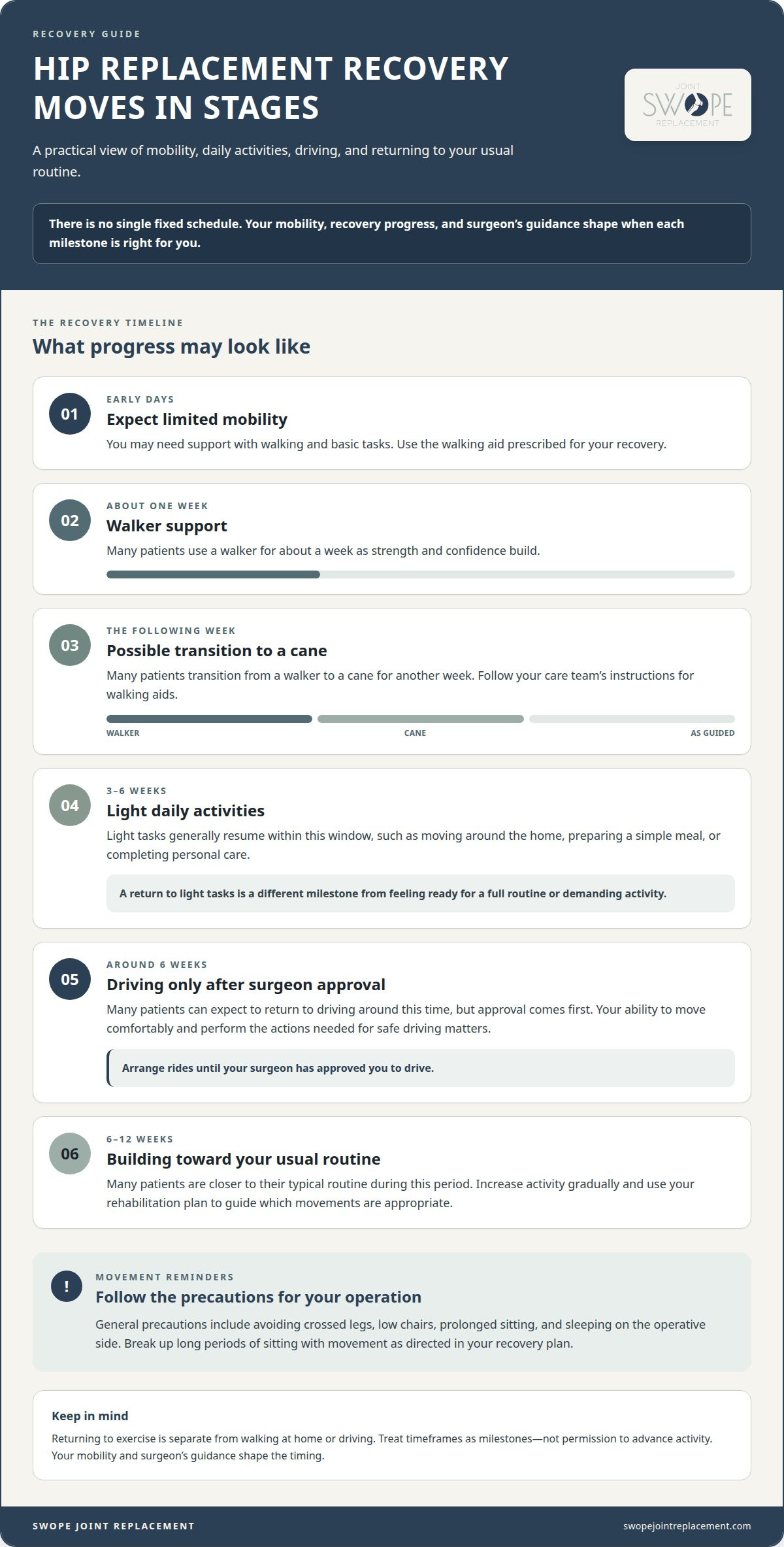
Recovery after total hip replacement progresses in stages, not on one fixed schedule. Mobility is often limited during the first few days, so you may need support with walking and basic tasks. Many patients use a walker for about a week, then transition to a cane for another week. These aids provide support as your strength and confidence build.
Light daily activities generally resume within 3-6 weeks. Examples include moving around the home, preparing a simple meal, or completing personal care. Returning to most of your usual routine often takes 6-12 weeks. These timeframes describe different milestones: managing light tasks is not the same as feeling ready for a full routine or demanding activity.
Driving requires particular care because it involves controlling a vehicle, responding quickly, and entering or leaving the car. Many patients can expect to return to driving around 6 weeks after total hip replacement, but surgeon approval comes first. The decision considers your ability to move comfortably and perform the actions needed for safe driving. Arrange rides until you’ve received that approval.
Follow the movement instructions for your operation. General precautions after hip replacement include avoiding crossed legs, low chairs, prolonged sitting, and sleeping on the operative side. Choose a seat that lets you stand without sinking into a deep position. Break up long periods of sitting with movement as directed in your recovery plan.
Early days: Expect limited mobility, and use your prescribed walking aid.
About one week: A walker is commonly used during this stage.
The following week: Many patients transition to a cane.
By 3-6 weeks: Light daily activities are generally within reach.
Around 6 weeks: Driving may resume after surgeon approval.
By 6-12 weeks: Many patients are closer to their typical routine.
Returning to exercise is a separate milestone from walking at home or driving. Increase activity gradually, following your rehabilitation plan to understand which movements are appropriate at each stage. A calendar can help you track changes in walking aids, therapy, and questions for follow-up visits. Don’t treat a target date as permission to advance activity.
Your recovery plan should connect daily goals with your surgical progress. If you’re planning a total hip procedure, explore hip replacement care as you consider how activity milestones fit your needs.
Benefits and outcomes of surgery
Hip replacement can help improve movement and make everyday activities more manageable. Recovery involves early movement, rehabilitation, and a gradual return to activities that matter to you.
Potential Benefits
The potential benefits of replacing a damaged hip are practical: easier walking and daily tasks, with the possibility of returning to lower-impact activities over time. Discuss your goals with your care team as you recover.
Movement can begin soon after surgery. Patients may start walking when they leave the operating area, usually with an aid such as a walker. This makes mobility part of recovery early on, while the device provides support.
Joint replacement may also help you work toward activities beyond the home. Cycling, golf, swimming, and hiking are examples of lower-impact sports to discuss with your physical therapist and surgeon. The right activity and timing depend on your recovery plan, not an assumption that every sport is suitable at the same stage.
Surgical Outcomes
Surgical outcomes include changes in movement, rehabilitation progress, and steps toward your personal activity goals. These milestones help you track recovery through functional changes, not just the passage of time.
Patients are up and moving within hours of inpatient or outpatient hip replacement surgery. Walking may start with a walker and continue through rehabilitation as mobility improves. Your care team’s instructions connect these early steps with healing and rebuilding confidence in movement.
Progress varies from person to person. To discuss your goals, identify specific activities that matter to you, such as walking through a grocery store, returning to regular exercise, or taking a hike. These examples give your surgeon and physical therapist practical goals to consider when planning rehabilitation.
Recovery from total hip replacement can take up to 6-12 months. That span reflects a longer healing process, not a period without progress. A return to one activity may happen before another, so distinguish early walking from more demanding exercise when reviewing your progress.
Early movement: Walking can begin after surgery with an assistive device.
Rehabilitation: Physical therapy supports healing and helps guide activity progression.
Activity goals: Discuss cycling, golf, swimming, or hiking with your physical therapist and surgeon.
Ongoing recovery: Track functional milestones as well as time since surgery.
Focus on safe, steady progress. Tell your care team about concerns and follow its guidance on increasing activity. A clear plan connects recovery to the mobility and routines you want to regain.
Hip replacement for arthritis or fractures
Hip replacement may be considered for conditions such as osteoarthritis or fractures. The reason for treatment matters because the appropriate type of replacement and care plan depend on the condition being assessed.
Hip osteoarthritis affects the joint and can make everyday movement difficult. Before considering surgery, the American Academy of Orthopedic Surgeons endorses non-operative measures to manage hip osteoarthritis. Physical therapy and general physical activity may help manage symptoms. These options can be part of a treatment plan before you and your surgeon consider an operation.
Notice how symptoms affect specific activities. For example, consider whether walking, exercise, or household tasks have become difficult, and discuss what treatments you’ve tried. These details give your surgeon a practical picture of your goals and daily challenges, beyond a general description such as “hip pain.”
A fracture raises different treatment questions from gradual joint changes caused by osteoarthritis. The evaluation focuses on the injury and the appropriate care. If replacement is being considered, ask whether the proposed procedure is partial or total and what that means for your treatment plan.
A total hip replacement replaces the entire hip joint with a prosthetic joint. A partial hip replacement replaces one side, typically the femoral side, while preserving the other. This distinction describes how much of the joint is replaced and provides a starting point for discussing the proposed procedure with your surgeon.
More than 450,000 total hip replacements are performed in the United States each year. That figure describes how commonly the procedure is performed, but it doesn’t determine whether it fits your circumstances. Your diagnosis, symptoms, treatment history, and personal goals remain central to the conversation.
For osteoarthritis: Discuss physical therapy and general physical activity as symptom-management options.
For a fracture: Ask how the injury shapes the treatment plan and whether replacement is being considered.
For either discussion: Clarify whether the proposed operation is partial or total hip replacement.
For your goals: Give concrete examples, such as difficulty walking or keeping up with an exercise program.
Understanding the difference can clarify a recommendation before you plan surgery. The decision to replace a joint depends on the condition being treated, the type of replacement under consideration, and the activities you hope to manage more comfortably, not simply on how common a procedure is.
Insurance coverage and reimbursement
With out-of-network hip replacement surgery, billing depends on the surgeon’s network status, the hospital or surgical facility, and the details of your plan. For hospital or accredited surgical-center surgery, federal protections also affect how your insurer applies cost sharing.
The main risks of choosing an out-of-network surgeon or hospital are greater financial responsibility and uncertainty about reimbursement. Network status is a billing distinction, not a measure of surgical quality; ask how your plan treats the surgeon, facility, and related services separately.
To find in-network hip replacement surgeons and hospitals near you, use your health plan’s provider directory or member services. Search your location, then verify the surgeon and the hospital or facility separately, since their network status may differ.
Before scheduling, review your plan documents and ask your insurer how it handles out-of-network benefits. Clarify whether prior authorization is required, what information the plan needs, and how it processes claims. Request written responses when possible and keep them with your records.
A reimbursement amount is not necessarily the same as the amount billed. Your plan’s terms determine how claims are processed and what costs may be your responsibility. Ask which documents are needed, who submits them, and how to track a claim. Don’t assume the plan will reimburse the full charge.
Ask for a written estimate that separates the surgeon’s professional services from hospital or facility charges and other services involved in your care. Clarify which items are included, which are billed separately, and how the estimate might change if your care needs change. This helps you compare expected costs with the benefits described in your plan.
Network status: Confirm the surgeon and hospital or facility separately.
Plan terms: Ask how out-of-network benefits and reimbursement are calculated.
Approval: Find out whether prior approval applies to your planned care.
Claims: Clarify who submits the paperwork and what records are needed.
Estimate: Request a written breakdown of the services and billing components.
Complications can change the care you need and the services billed, so ask how your plan processes additional care related to surgery. Keep estimates, insurer responses, authorizations, and claim records together. If an explanation of benefits differs from an estimate, use those documents to identify the item or benefit that needs clarification.
For a clearer discussion of out-of-network coverage alongside hip replacement planning, explore insurance options.
Swope Joint Replacement: out of network insurance
Swope Joint Replacement offers out-of-network insurance options for patients considering hip replacement. If you’re weighing surgery and insurance reimbursement, this is a natural point to discuss how care and coverage fit into your decision.
Care options include Direct Anterior Hip Replacement and Revision Hip Replacement. A conversation can help you understand the surgical approach being considered and how out-of-network care relates to your insurance questions. Coverage and reimbursement depend on your plan’s terms, so keep the insurer’s benefit information in view as you consider your next steps.
If you’re ready to discuss your care, contact Swope Joint Replacement.
Make your next decision with clarity
Bring your surgical priorities and insurance questions into the same conversation. As you consider out-of-network hip replacement surgery, focus on your clinical needs and your plan’s terms. Your circumstances can help determine which questions to address first.
Swope Joint Replacement offers Direct Anterior Hip Replacement, Knee Replacement, and Revision Hip Replacement. A conversation can help you discuss the relevant care option and how out-of-network insurance fits into your planning. You can take time to consider the information and decide what feels right for your needs.
For a thoughtful discussion of your options, contact Swope Joint Replacement. A clear next step can help you approach the decision with greater confidence and move forward at your own pace.
Frequently Asked Questions
How do I know if I am a candidate?
Candidacy depends on your hip condition, overall health, and ability to manage recovery safely. An assessment can consider how symptoms affect specific tasks, such as getting dressed or walking through a store, and whether non-operative treatment has helped. Swope Joint Replacement serves patients in Overland Park and the greater Kansas City area, including Olathe, Lees Summit, Lenexa, Leawood, Blue Springs, and Independence.
How soon can I return to regular activities like walking, climbing stairs, and driving?
Walking, using stairs, and driving return at different stages, depending on your progress and your surgeon’s guidance. Driving is often possible around six weeks after total hip replacement, with your surgeon’s approval. Ask your care team how to manage your home’s stairs, including railings and the steps you use most. Don’t rely on a date alone to decide you’re ready.
How much does out-of-network hip replacement surgery cost in the U.S.?
Costs depend on the individual case and the services involved. Swope Joint Replacement provides transparent cash pricing for office visits and in-office procedures. Surgeries at a hospital or accredited surgical center are billed out of network. Under the No Surprises Act, insurers must apply the same deductible and cost-sharing structure as if the provider were in network. Keep office pricing separate from surgical facility charges when reviewing an estimate.
Does health insurance cover surgery with an out-of-network surgeon?
Swope Joint Replacement is out of network with all insurance carriers by design so we can place patient care first. Office visits and in-office procedures have transparent cash pricing. Surgeries at a hospital or accredited surgical center are billed out of network; under the No Surprises Act, insurers must apply the same deductible and cost-sharing structure as if the provider were in network.
How do out-of-network deductibles, coinsurance, and out-of-pocket maximums apply to hip replacement?
Your plan documents explain how out-of-network benefits apply to deductibles, coinsurance, and maximums. A deductible is the amount you pay before applicable benefits begin; coinsurance is your share of covered costs. Ask whether out-of-network spending counts toward the relevant maximum, and review the explanation of benefits after claims are processed. For qualifying hospital or accredited-center surgery, the deductible and cost-sharing structure follows the in-network structure described above.
Can a patient get prior authorization for out-of-network hip replacement surgery?
Ask your health plan whether prior authorization is required and how to request it. Authorization reviews proposed care, but it does not determine every claim or reimbursement amount. Clarify which clinical records are needed, who submits them, and how the decision will be delivered. Keep the response with your plan documents and surgical records for later claim discussions.
What are the No Surprises Act protections for hip replacement surgery?
For surgery at a hospital or accredited surgical center, the No Surprises Act requires insurers to apply the same deductible and cost-sharing structure as if the provider were in network. This affects how those services are treated for cost sharing. It does not mean every service is free or every charge is paid by the plan. Review your explanation of benefits to see how a claim was processed.
How can I appeal an insurance denial for hip replacement?
Start with the denial notice and follow its appeal instructions and deadline. Identify the reason for denial, then submit a written response with relevant claim details and supporting medical records. If the decision concerns medical necessity, for example, include records that address the insurer’s stated concern. Keep copies of your appeal and the insurer’s response, and follow the plan’s process if you decide to challenge the decision further.



Comments