Out-of-Pocket Knee Replacement Surgery: Understand Your Options

What if the headline estimate for out of pocket knee replacement surgery doesn’t tell you what you’ll actually owe? A figure can look clear while leaving important questions unanswered, such as whether it covers the surgeon, facility, anesthesia, implant, and rehabilitation. The details behind the number matter.
It’s reasonable to want a clear picture of your financial responsibility before making decisions about surgery. Cash pricing and out-of-network insurance follow different paths, and neither automatically tells you which option will cost less. With out-of-network benefits, your plan’s terms and reimbursement rules can affect your share. With cash pay, the estimate’s scope matters: a quoted amount may not represent every part of the care episode.
This article explains what can shape an individualized knee replacement estimate and how cash-pay and out-of-network arrangements differ. You’ll also find practical questions to clarify before discussing a personalized financial plan, so you can compare the options and understand what each estimate does and doesn’t include.
Table of Contents
Out-of-Pocket Knee Replacement Surgery: What Does the Estimate Mean?
Which Factors Can Change Out-of-Pocket Knee Replacement Surgery Costs?
Cash Pay or Out-of-Network Benefits: How Do the Paths Differ?
How to Prepare for a Clear Knee Replacement Cost Conversation
Discuss Out-of-Pocket Knee Replacement Surgery With Swope Joint Replacement
Out-of-Pocket Knee Replacement Surgery: What Does the Estimate Mean?
Your out-of-pocket responsibility is the portion of care expenses you’re expected to pay yourself. It depends on the planned care and how you pay. With insurance, your plan’s out-of-network terms may affect your share. With cash pricing, the quoted amount and the services it covers shape the amount you’re responsible for directly.
An estimate is a planning tool, not a guarantee of insurance coverage, reimbursement, or your final payment. It gives you a basis for understanding expected expenses, but it may rely on assumptions about the procedure, care setting, or services involved. A final bill can differ if the care provided or billing details differ from those assumptions.
What can an out-of-pocket estimate describe?
A useful estimate should make its scope clear. It should identify the planned procedure and the services and assumptions used to calculate the amount. For example, the surgeon’s professional services may be billed separately from facility services. Depending on the care plan, anesthesia, the implant, or rehabilitation may also be separate items. Don’t assume these are included. Use the individualized estimate to clarify what it covers, what may be billed separately, and which services remain undetermined.
This distinction matters because a number can look comprehensive without describing the full episode of care. If you’re comparing estimates, compare their scope as well as their totals. A lower-looking figure may describe fewer services, while a broader estimate may account for more of the planned care. Look for the services named in each estimate, not just the total amount.
Why online averages may not fit your situation
Online figures can offer context, but they aren’t a personalized calculation of out of pocket knee replacement surgery. A total replacement and a partial replacement involve different treatment plans. The care setting, services included, and payment arrangement can also change what a quoted amount represents. Your surgeon’s recommendation and individualized plan matter more than a broad online average.
Check what procedure and services a published figure actually describes. For instance, the example from Sidecar Health referenced in this article’s research is for ACL surgery, not knee replacement, so it shouldn’t be treated as a knee replacement estimate. For an overview of the procedure itself, see Knee replacement surgery. Understanding what the surgery involves can help you make sense of why estimates need to reflect the care being planned, rather than a general figure found online.
For a clearer discussion, focus on three points: the planned procedure, the services represented in the estimate, and the payment pathway. That gives you a more useful starting point than an average that may describe a different operation or a different set of services.
Which Factors Can Change Out-of-Pocket Knee Replacement Surgery Costs?
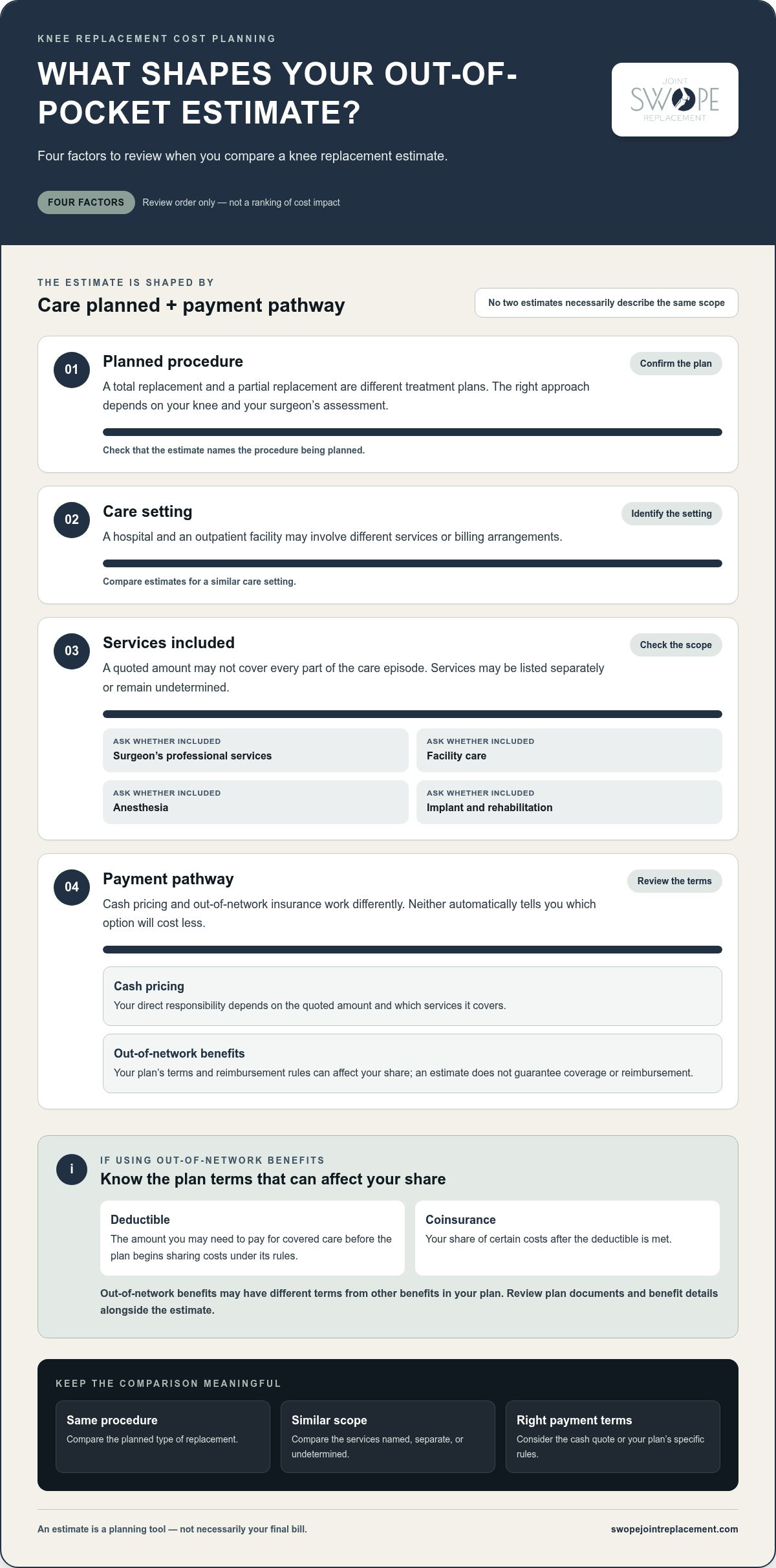
An estimate is shaped by more than the name of the operation. It depends on both the care planned and the payment pathway you choose. Understanding these variables helps you see why a figure for one patient may not describe another person’s expected responsibility.
How the planned procedure and care setting matter
A total knee replacement addresses the joint more broadly, while a partial replacement treats a more limited area when the clinical plan calls for it. The right approach depends on your knee and your surgeon’s assessment, not on which option appears less costly. For a straightforward overview of the procedure, see MedlinePlus. You can also learn more about partial knee replacement.
The estimate should reflect the procedure being planned and the care setting. A hospital and an outpatient facility may involve different services or billing arrangements. The services represented in the estimate matter, too. Surgeon’s professional services, facility care, anesthesia, the implant, and rehabilitation may be handled differently, so review which items are included, separate, or still undetermined. When comparing estimates, check that you are looking at the same type of procedure and a similar scope of services.
How insurance benefits can affect your responsibility
If you’re considering out-of-network benefits, your plan’s terms can affect how much you ultimately pay. The deductible is the amount you may need to pay for covered care before the plan begins sharing costs under its rules. Coinsurance is your share of certain costs after the deductible is met. Your out-of-pocket responsibility is the amount you’re responsible for paying, based on the care and payment arrangement.
Plan rules can vary. Your deductible may not be met, coinsurance may apply, and out-of-network benefits may have different terms from other benefits in your plan. These details can influence your expected share, but they don’t establish a guaranteed payment or reimbursement amount. Review your plan documents and benefit details alongside the estimate. If you’re weighing out-of-pocket knee replacement surgery through a cash-pay or out-of-network pathway, compare what each estimate includes and how your plan applies its terms.
Procedure: Is the estimate based on total or partial replacement?
Setting and services: Which care and billed services does it represent?
Benefits: What deductible, coinsurance, and out-of-network rules may apply?
For an individualized discussion of your knee replacement plan and payment options, explore Swope Joint Replacement.
Cash Pay or Out-of-Network Benefits: How Do the Paths Differ?
Cash pay and out-of-network benefits are different ways to approach payment for knee replacement care. Cash pricing is a direct payment arrangement with a stated estimate. Out-of-network benefits involve your insurance plan’s rules, which may affect eligibility, reimbursement, and your final responsibility. Neither route guarantees a lower personal cost. Compare the estimate and the terms that apply to you.
What to understand about cash-pay pricing
Direct cash pricing gives you a payment pathway outside an insurance-benefit calculation. It isn’t a promise of universal savings or an automatic all-inclusive amount. Read the estimate’s scope: identify the planned care, the services represented, and any assumptions or separate items. A defined estimate makes it easier to understand what the quoted amount describes, but it should not be mistaken for a guarantee that every part of the care episode is included.
What to understand about out-of-network benefits
Swope Joint Replacement operates outside in-network insurance arrangements and offers out-of-network options. Out-of-network care is not the same as in-network billing. Your plan determines whether benefits apply and how reimbursement is handled; coverage or a particular payment amount can’t be assumed. Review your plan documents and understand any claim or reimbursement steps before relying on benefits. Keep the estimate’s scope in view as you consider what your plan may process.
Care setting can also shape what an estimate describes. If you’re weighing where knee replacement may take place, explore this outpatient knee replacement overview. Then compare the cash estimate with your plan-specific information. The better comparison is not simply which headline figure is smaller, but what each pathway means for your out of pocket knee replacement surgery responsibility.
For an individualized discussion of knee replacement care and payment options, review Swope Joint Replacement’s approach.
How to Prepare for a Clear Knee Replacement Cost Conversation
A little preparation can make a financial discussion more focused and useful. Bring the details that connect your planned care with your payment pathway, then separate what the estimate states from what still depends on your plan or care arrangements. You don’t need to share private insurance details publicly to get ready.
Information to have ready before reviewing an estimate
Start with the clinical plan. Note whether your discussion concerns total or partial knee replacement, if that has been established. If you’re considering out-of-network benefits, bring your plan documents or benefit summary, including deductible information and any out-of-network provisions. Keep these materials private and use them during your individual discussion.
Next, have the estimate available and mark any terms or items you’d like explained. A concise sequence helps:
Identify the planned procedure and the care setting under discussion.
Gather relevant plan information, including deductible and out-of-network benefit details if you may use insurance.
Review the estimate’s scope and note which services and assumptions it describes.
Clarify next steps, including what remains plan-dependent or may change as the care plan is finalized.
Questions that help clarify financial responsibility
Use specific questions to distinguish known details from open variables. Ask which services are included and which may be billed separately, if applicable. Find out whether the estimate assumes a particular procedure or care setting. If you’re considering insurance benefits, ask how your plan’s terms could affect your responsibility, without treating a benefit summary as a promise of coverage or reimbursement.
It can help to sort details into two groups. Confirmed estimate details are the services and assumptions explicitly stated in the estimate. Plan-dependent or variable details may include how an insurer processes out-of-network care, reimbursement, or items not yet specified in the care plan. This simple distinction makes it easier to understand what you know and what still needs clarification about out of pocket knee replacement surgery.
Swope Joint Replacement’s personalized care model includes direct physician access, so you can discuss questions about the planned knee replacement with the treating surgeon. For more context, read the concierge orthopaedic care overview.
Bring your procedure details, plan documents, and questions to a personalized conversation about your care and financial options. Discuss your knee replacement options with Swope Joint Replacement.
Discuss Out-of-Pocket Knee Replacement Surgery With Swope Joint Replacement
Planning knee replacement involves both a clinical decision and a financial one. At Swope Joint Replacement, patients in Overland Park and the Kansas City area can discuss primary total or partial knee replacement, transparent cash pricing, and out-of-network insurance options. Patients from Olathe, Lee’s Summit, Lenexa, Leawood, Blue Springs, and Independence can also explore care with the practice. The aim is to connect the estimate to the care being considered, so you can better understand the choices in front of you.
A personalized discussion, not a one-size-fits-all figure
Your estimate conversation should reflect your procedure, care plan, and payment pathway. A discussion about partial replacement may involve different planned care than one about total replacement. The estimate should also be understood in light of the services it describes and, if you’re considering insurance, the terms of your individual plan.
Transparent pricing helps you make informed decisions, but it doesn’t make an estimate a guarantee of the final amount. Cash pricing is a direct payment pathway. Out-of-network benefits are governed by your plan and don’t mean in-network billing. Neither option promises savings, coverage, or a specific reimbursement. The most useful conversation clarifies what’s known, what depends on plan rules, and what details may still vary.
Bring your questions and any relevant plan information to a discussion with the treating surgeon. Direct physician access gives you the opportunity to talk through the planned procedure and how it relates to your financial questions, rather than treating a general online figure as a personal estimate for out of pocket knee replacement surgery.
Next steps for Kansas City-area patients
If you’re considering knee replacement, you can prepare by noting whether total or partial replacement has been discussed, gathering your plan’s benefit details if you may use out-of-network coverage, and listing questions about estimate scope. Keep personal insurance documents private and bring them to your individual conversation. This preparation can help focus the discussion on your care and the payment pathway you’re considering.
Swope Joint Replacement’s concierge model is centered on personalized care and direct access to the physician. You can discuss your circumstances, understand the estimate’s assumptions, and consider cash-pay or out-of-network options without assuming that one path is right for everyone. The decision remains yours, informed by your clinical plan and the financial details that apply to you.
Explore knee replacement care and arrange a conversation about your procedure and financial questions with Swope Joint Replacement.
Move Forward With a Clearer Financial Picture
Your out-of-pocket responsibility depends on both the knee replacement care being planned and the payment pathway you choose. An estimate is most useful when its included services and assumptions are clear. Cash pricing and out-of-network benefits work differently, so compare the estimate with your own plan details rather than assuming either option will cost less.
Swope Joint Replacement offers transparent cash pricing and out-of-network options, with personalized orthopaedic care and direct physician access. A conversation about your procedure and financial questions can help you understand the details relevant to your situation, without treating an estimate as a guarantee of coverage or final payment.
When you’re ready, discuss your knee replacement options with Swope Joint Replacement and bring your questions to a personalized conversation. With clear information and thoughtful guidance, you can make decisions with greater confidence.
Frequently Asked Questions
How much does out-of-pocket knee replacement surgery cost?
There isn’t one amount that applies to every patient. Your out-of-pocket knee replacement surgery responsibility depends on the planned procedure, the services represented in the estimate, and your payment pathway. With insurance, plan terms and benefit details can affect your share. With cash pricing, the estimate’s scope matters. Swope Joint Replacement offers transparent cash pricing, but your personalized estimate should clarify what it covers rather than rely on a general online figure.
Does health insurance cover out-of-network knee replacement surgery?
It may, depending on your specific plan and its out-of-network provisions. Coverage, reimbursement, and your final responsibility aren’t guaranteed by the fact that you have insurance. Swope Joint Replacement operates outside in-network insurance arrangements and offers out-of-network options. Review your plan documents for applicable benefits, deductible, coinsurance, and any claim or reimbursement process, then compare those details with the services and assumptions described in your estimate.
Is cash-pay knee replacement cheaper than using insurance?
Not necessarily. Cash pricing and out-of-network benefits follow different payment arrangements, and neither is automatically less expensive for every patient. A cash estimate may make the stated amount easier to understand, while insurance benefits depend on plan rules and how the care is processed. Compare the scope of the cash estimate with your plan-specific benefits, including possible reimbursement and your share. Don’t assume a lower headline figure means a lower total personal cost.
What should a knee replacement estimate include?
A useful estimate should identify the planned procedure, the services it represents, and the assumptions behind the quoted amount. Check whether it separates the surgeon’s professional services from facility charges. Depending on the care plan, anesthesia, implant, or rehabilitation may be addressed separately. Ask which items are included, which may be billed separately, and which are still undetermined. This helps you understand what the estimate describes without treating it as a guaranteed final bill.
Can I use out-of-network benefits for knee replacement surgery?
You may be able to use out-of-network benefits if your plan’s terms allow them, but eligibility and reimbursement depend on your specific policy. Swope Joint Replacement offers out-of-network options and does not provide in-network insurance billing. Review your plan’s benefit details and reimbursement process before relying on benefits. The practice serves patients in Overland Park, Kansas City, Olathe, Lee’s Summit, Lenexa, Leawood, Blue Springs, and Independence.
Can I use an HSA or FSA to pay for knee replacement surgery?
Whether HSA or FSA funds can be used for a particular knee replacement expense depends on current rules and the terms of your account. Don’t assume every service or charge qualifies. Review your account documents and current guidance, and confirm how the specific expense is treated with your plan administrator or tax professional. Keep the estimate available so you can compare the expense descriptions with the rules that apply to your account.
Does an online knee surgery cost estimate tell me what I will pay?
No. An online estimate can offer general context, but it may not reflect your planned procedure, care setting, included services, or payment arrangement. Insurance estimates also can’t account for every detail of how your plan processes a claim. Use online figures as a starting point, not a personal quote or guarantee. A tailored estimate and a review of your plan documents can help clarify which details are established and which remain variable.



Comments