Partial Knee Replacement in Kansas City: Is It Right for You?

A smaller operation isn’t automatically the better fit. If you’re researching partial knee replacement kansas city, the key question is whether arthritis is limited to one part of your knee or affects multiple compartments. That distinction can help guide a discussion about partial or total knee replacement.
It’s understandable to look for an option that addresses your pain while supporting the activities and mobility that matter to you. Candidacy depends on more than symptoms alone: your examination, imaging, and the condition of the rest of your knee all matter.
This article explains how partial and total knee replacement differ, what a surgeon may consider when evaluating partial replacement, and what to ask during a Kansas City-area orthopaedic consultation. It also covers recovery expectations and insurance questions, including what to clarify about out-of-network benefits. Swope Joint Replacement offers partial and total knee replacement consultations, so an individual evaluation can help you understand which options may fit your situation.
Table of Contents
Partial Knee Replacement in Kansas City: What the Procedure Treats
Knee pain can make everyday movement harder and leave you wondering whether a partial replacement could address the problem, or whether more of the joint is involved. A useful starting point is understanding which part of the knee is damaged and how that finding relates to your symptoms.
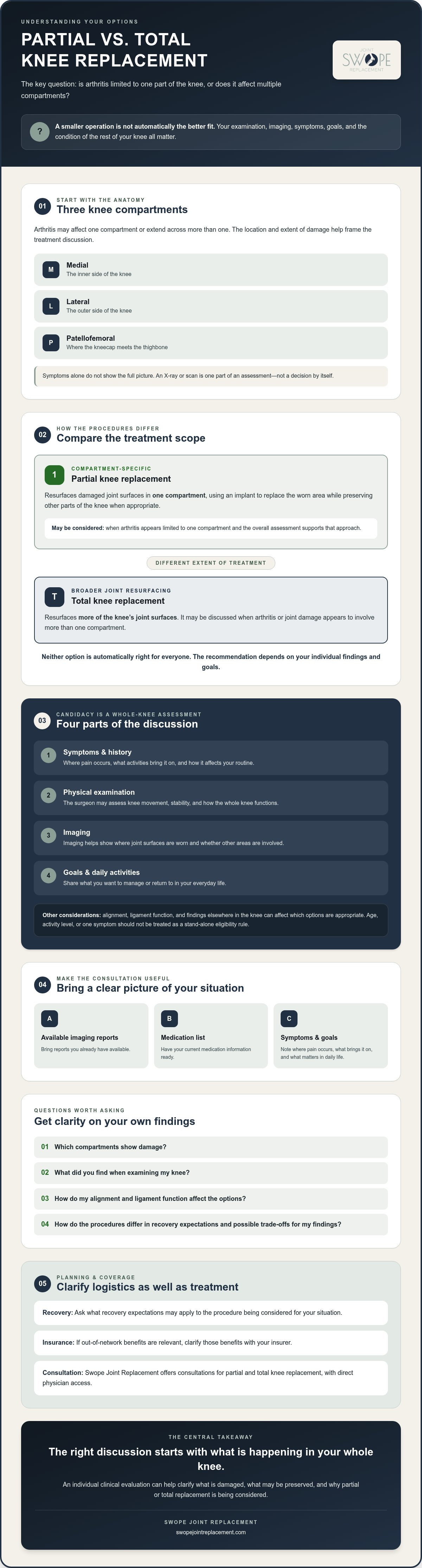
The knee has three compartments where the bones meet:
Simple knee compartment map
Medial: The inner side of the knee.
Lateral: The outer side of the knee.
Patellofemoral: The area where the kneecap meets the thighbone.
Arthritis may affect one compartment or extend across more than one. The location and extent of damage help frame the treatment discussion, but symptoms alone don’t show the full picture.
What does a partial knee replacement replace?
A partial knee replacement resurfaces the damaged joint surfaces in one compartment, using an implant to replace the worn area while preserving other parts of the knee when appropriate. The structures that remain depend on your anatomy and surgical plan. The term unicompartmental knee arthroplasty refers to this compartment-specific approach.
How is partial replacement different from total replacement?
A partial replacement addresses damage in one compartment. A total knee replacement resurfaces more of the knee’s joint surfaces. Neither option is automatically right for everyone. A surgeon considers the extent and location of arthritis, examination findings, imaging, and your goals before recommending a treatment path.
If your pain seems focused in one area, ask whether the examination and imaging show damage limited to that compartment. An X-ray or scan is one part of the assessment, not a decision by itself. Your symptoms matter, too, but they can’t establish candidacy alone.
If you’re exploring partial knee replacement kansas city, ask how the findings in your own knee support or rule out a compartment-specific procedure. An individual evaluation can clarify what is damaged, what may be preserved, and why partial or total replacement is being considered. The aim is a well-grounded choice, not a predetermined answer.
How Surgeons Evaluate Partial Knee Replacement Candidacy
Deciding whether partial replacement is appropriate takes more than locating pain or spotting arthritis on an image. A surgeon considers your symptoms, physical examination, imaging, and personal goals together. The assessment looks at where the joint is worn, how the whole knee functions, and what matters to you in daily life.
What findings may support considering a partial replacement?
Arthritis that appears limited to one compartment may prompt a discussion about partial replacement. It isn’t a self-diagnosis or a decision based on one X-ray. A surgeon may review imaging alongside an examination to assess the affected joint surfaces, knee movement, stability, and alignment. Findings elsewhere in the knee can also affect which options are appropriate.
Before your appointment, note where you feel pain, what activities bring it on, and how it affects your routine. Describe your goals as specifically as you can, such as managing discomfort during everyday tasks or returning to particular activities. Age, activity level, and any one symptom shouldn’t be treated as stand-alone eligibility rules.
When might a surgeon discuss total knee replacement instead?
If arthritis or joint damage appears to involve more than one compartment, your surgeon may discuss total knee replacement. The conversation may also account for symptoms, examination findings, alignment, and ligament function. Taken together, these details help assess whether a compartment-specific procedure makes sense or whether treating more of the joint surfaces is worth considering.
No single image or diagnosis determines the operation. Imaging provides important information, but it needs to be interpreted alongside your history and a clinical examination. If your symptoms and imaging seem inconsistent, ask how the surgeon is weighing each finding and whether further assessment could clarify the picture.
Only an individual clinical evaluation can determine whether partial replacement is appropriate for you. If you’re exploring partial knee replacement kansas city, consider asking: “Which compartments show damage?”, “What did you find when examining my knee?”, and “How do my alignment and ligament function affect the options?” Clear answers can help you understand the reasoning behind a recommendation, including why total replacement may or may not be part of the discussion.
A Kansas City-area consultation gives you an opportunity to review your findings and goals directly with a physician. Learn more about a personalized knee replacement evaluation with Swope Joint Replacement.
Partial vs. Total Knee Replacement: Benefits, Trade-Offs, and Questions
Choosing between partial and total knee replacement isn’t simply a matter of choosing the smaller operation. A partial procedure treats a more limited area and may preserve more of the knee’s unaffected joint structures. That approach depends on arthritis being appropriately limited. If damage extends beyond one compartment, a partial replacement may not address the full problem. A total replacement treats more of the joint surfaces, but it isn’t automatically the right choice for every patient.
What trade-offs should you discuss with your surgeon?
Preserving more of the knee’s unaffected structures may be relevant, but it doesn’t outweigh the need to match the operation to the pattern of joint damage. If arthritis affects multiple compartments, a partial replacement may leave other sources of joint damage unaddressed. Recovery and outcomes vary between people and procedures. Ask what expectations are realistic for your health, knee findings, and daily needs rather than relying on a general promise.
Implant longevity also deserves a measured conversation. Ask what current clinical evidence says about the options that apply to your situation, and how future wear, progression of arthritis, or revision surgery may factor into the decision. General statistics can’t predict an individual outcome. Comparative claims should be explained in the context of your specific circumstances.
Which questions clarify the comparison for your situation?
Which compartments show damage, and how did the examination and imaging inform that assessment?
What makes partial replacement a reasonable option for me, or why might it not be appropriate?
What findings would support discussing total replacement instead?
How do my goals, health factors, and expectations shape your recommendation?
What should I understand about recovery, implant longevity, and possible future treatment?
If you’re considering partial knee replacement kansas city, use these questions to understand the reasoning behind each option. A careful comparison connects your knee’s condition with your priorities without assuming one procedure is superior for everyone.
Planning a Partial Knee Replacement Consultation in the Kansas City Area
Preparation can make a consultation more useful. Gather available records and decide what you most want to understand. At the appointment, review your symptoms and findings with the surgeon before weighing options. If surgery is discussed, ask about the proposed procedure, alternatives, recovery planning, and follow-up.
What should you bring and ask at an evaluation?
Bring prior imaging reports, relevant medical records, and a current medication list. Contact the practice beforehand to ask whether it needs the original image files or whether reports are sufficient. A brief symptom history can help you explain when discomfort began, where you feel it, what makes it better or worse, and how it affects walking, stairs, work, or activities you value.
Be ready to discuss treatments you’ve already tried and your goals. Ask how the surgeon distinguishes arthritis limited to one compartment from broader knee involvement, and how the examination and imaging inform that assessment. You can also ask which alternatives are reasonable, what recovery planning may involve, and what follow-up would look like for the option being discussed.
How should you understand insurance and payment options?
Confirm practical details directly with the Kansas City-area practice, including appointment location, scheduling, and billing arrangements. Swope Joint Replacement operates outside in-network insurance arrangements. The practice offers cash pricing and out-of-network options, but coverage and potential reimbursement depend on your individual plan. Ask the practice what payment information it can provide, then contact your insurer to understand your out-of-network benefits. Don’t assume a service is in-network or that a claim will be reimbursed.
For a partial knee replacement kansas city consultation, keep your questions and records together and take notes during the discussion. You should leave with a clearer understanding of the findings, why a procedure is or isn’t being considered, and what information you still need before deciding.
If you’re ready to discuss your knee findings and treatment options with a physician, request a personalized knee evaluation with Swope Joint Replacement.
Discuss Partial Knee Replacement with Swope Joint Replacement
Understanding the difference between partial and total knee replacement is a useful first step. Next, discuss how your symptoms, examination, imaging, and goals fit together. Swope Joint Replacement offers partial and total knee replacement in the Kansas City area, with personalized orthopaedic consultations to review whether either approach may be appropriate for you.
What can you expect from a personalized knee evaluation?
A consultation is an opportunity to review what you’re experiencing, what the available findings show, and what you hope to regain or continue doing. Ask the physician to explain which parts of the knee appear affected and how that shapes the options. The evaluation can also include discussion of non-operative treatment options when appropriate. Surgery isn’t assumed to be the only path, and an evaluation doesn’t guarantee a particular procedure or result.
Swope Joint Replacement’s concierge orthopaedics model includes direct physician access. You can discuss your questions with a physician and better understand the reasoning behind the options presented. Bring your priorities to the conversation, whether you want to manage discomfort during daily activities or understand how different approaches may fit your overall health and plans.
How can Kansas City-area patients take the next step?
If you’re considering partial knee replacement kansas city, contact the practice to ask about an evaluation and confirm current appointment logistics, including location and scheduling. Clarify payment details as well. Swope Joint Replacement operates outside in-network insurance arrangements and offers cash pricing and out-of-network options. Ask the practice about payment information and contact your insurer about your out-of-network benefits. Coverage and reimbursement depend on your plan, so don’t assume either is guaranteed.
Before the conversation, write down your main questions: what supports considering a partial procedure, what alternatives are relevant, and what next steps would involve. If you’re also exploring hip care, the Direct anterior hip replacement patient guide covers a separate procedure offered by the practice.
When you’re ready, discuss your knee replacement questions with Swope Joint Replacement. A measured conversation can help you understand your options and decide what information you need next.
Take the Next Step With a Clearer Understanding
The central question is whether arthritis is limited to one knee compartment or affects more of the joint. That distinction, together with your examination, imaging, health, and goals, helps a surgeon discuss whether partial or total knee replacement may be appropriate. Neither option is right for everyone, and an individual evaluation is essential.
If you’re considering partial knee replacement kansas city, Swope Joint Replacement offers consultations for both partial and total knee replacement through a concierge orthopaedic model with direct physician access. You can review your findings, alternatives, and practical next steps in a personalized conversation. The practice operates outside in-network insurance arrangements and offers cash pricing and out-of-network options. Confirm payment details with the practice and check your benefits directly with your insurer.
Bring your questions and share what you hope to return to. Discuss your knee replacement questions with Swope Joint Replacement to review your options with a physician.
Frequently Asked Questions
What is the difference between partial and total knee replacement?
A partial knee replacement resurfaces the damaged joint surfaces in one compartment, while a total knee replacement replaces more of the knee’s joint surfaces. With a partial procedure, other parts of the knee may remain, depending on your anatomy and surgical plan. The choice depends on the extent and location of joint damage, examination findings, and your goals. Neither procedure is the right choice for everyone.
Who is a candidate for partial knee replacement?
A person may be considered for partial knee replacement when arthritis appears limited to one knee compartment and the overall clinical evaluation supports it. A surgeon considers symptoms, examination findings, imaging, alignment, ligament function, and personal goals together. Age, activity level, or pain in one area alone doesn’t establish candidacy. Only a surgeon who evaluates your individual knee can determine whether a partial procedure is appropriate.
Is partial knee replacement easier to recover from than total knee replacement?
Recovery varies, so a partial knee replacement shouldn’t be assumed to be easier for every patient. The procedure performed, your overall health, knee condition, and individual recovery all matter. Ask your surgeon what recovery planning may involve for each option in your case, including movement, support at home, and follow-up. A personalized discussion is more useful than relying on a general timeline or a promise of faster recovery.
Can partial knee replacement be converted to total knee replacement later?
Yes, a partial replacement may sometimes be revised to a total knee replacement if later findings make that appropriate. For example, a surgeon may consider further treatment if arthritis progresses in other parts of the knee or an implant develops a problem. Whether revision is suitable depends on the reason, your knee’s condition, and your overall health. Ask your surgeon how future treatment possibilities apply to your situation.
How do doctors decide between partial and total knee replacement?
Doctors weigh your symptoms, physical examination, imaging, and goals to understand the condition of the whole knee. They consider whether damage appears confined to one compartment or is more widespread, along with factors such as alignment and ligament function. No single symptom or image determines the procedure by itself. Ask your surgeon which findings support each option and how those findings connect to your priorities.
Does Swope Joint Replacement accept in-network insurance for knee replacement?
No. Swope Joint Replacement operates outside in-network insurance arrangements. The practice offers cash pricing and out-of-network options, but coverage and reimbursement depend on your individual plan and aren’t guaranteed. Before scheduling, ask the practice about its payment details and contact your insurer to understand any out-of-network benefits, requirements, or potential costs. Confirm current information directly with both the practice and your insurance provider.
Where can I discuss partial knee replacement near Kansas City?
You can discuss partial and total knee replacement with Swope Joint Replacement, which provides personalized orthopaedic consultations in the Kansas City area. Its concierge care model includes direct physician access for discussing your symptoms, findings, goals, and treatment options. The practice’s local focus includes Overland Park, Kansas City, Olathe, Lee’s Summit, Lenexa, Leawood, Blue Springs, and Independence. Contact the practice directly to confirm appointment location and current logistics.


Comments