Revision Hip Replacement Specialist in Kansas City: How to Choose the Right Care

If you’re searching for a revision hip replacement specialist Kansas City residents can consult about a worn or failing implant, the first question is not simply whether the implant needs to be replaced. It is also why it is causing trouble and what options fit your situation. Revision surgery is more complex than a first hip replacement, so the right plan depends on an individualized assessment.
A careful evaluation can help clarify what may be affecting your implant and which treatment options are worth discussing. You deserve clear explanations, time to ask questions, and a plan shaped around your health and priorities. At Swope Joint Replacement, revision hip care is personalized, with direct physician access to discuss your case.
This guide explains how revision surgery differs from primary replacement, what information can make a consultation more productive, and what to consider when evaluating a specialist and care arrangements. It also covers cash pricing and out-of-network options for people considering care in Kansas City and nearby communities.
Table of Contents
Why revision hip replacement in Kansas City calls for a specialist-focused assessment
How a revision hip specialist develops an individualized surgical plan
How to compare revision hip replacement specialists in Kansas City
What to prepare before a Kansas City revision hip consultation
Revision hip replacement care with Swope Joint Replacement in Kansas City
Why revision hip replacement in Kansas City calls for a specialist-focused assessment
A recommendation to revisit a hip replacement can raise difficult questions: What has changed? What are the options? Does surgery make sense for you? The answers start with an assessment of your individual case, not a checklist of symptoms or a search result. A revision-focused consultation gives you a chance to understand the concern and discuss a plan with an orthopaedic specialist.
Revision hip replacement is surgery to address a previous hip implant, which may involve revising or replacing part or all of the implant. The procedure depends on the assessment and treatment goals. Revision is not one standardized operation.
What makes revision hip replacement different from primary surgery?
Primary hip replacement treats the hip before an artificial joint has been implanted. Revision surgery starts with an existing implant and the history of that joint. Why revision is being considered, the implant’s condition, and your health and priorities can all influence the recommended approach.
Revision planning is therefore individualized. Surgery may involve addressing or replacing implant components, but not every patient needs the same intervention. A general overview of hip replacement surgery can provide background on implants and revision. A clinician can explain how that information applies to your case.
A specialist-focused assessment connects the facts of your situation to the options under consideration. It gives you an opportunity to ask why a particular approach is being discussed, what uncertainties remain, and how your goals fit into the decision. An online symptom list cannot determine whether revision is appropriate for you.
When should you seek a revision-focused consultation?
If another clinician has raised revision as an option, you can discuss that recommendation with an orthopaedic specialist who evaluates revision cases. The purpose is not to assume surgery is necessary. It is to understand the concern, review available information, and consider whether revision or another course of care is appropriate.
Bring the recommendation and any records you already have. They can help frame the conversation, but they do not replace an examination or clinical judgment. Concerns about a worn or potentially failing implant call for careful, case-specific discussion. For more detail, explore how a surgeon evaluates a failing hip implant.
If you’re searching for a revision hip replacement specialist Kansas City patients can consult, focus on whether the discussion explains why revision is being considered and how your circumstances will guide next steps. Clear explanations can make a complex decision easier to understand, without requiring you to decide before you have the information you need.
How a revision hip specialist develops an individualized surgical plan
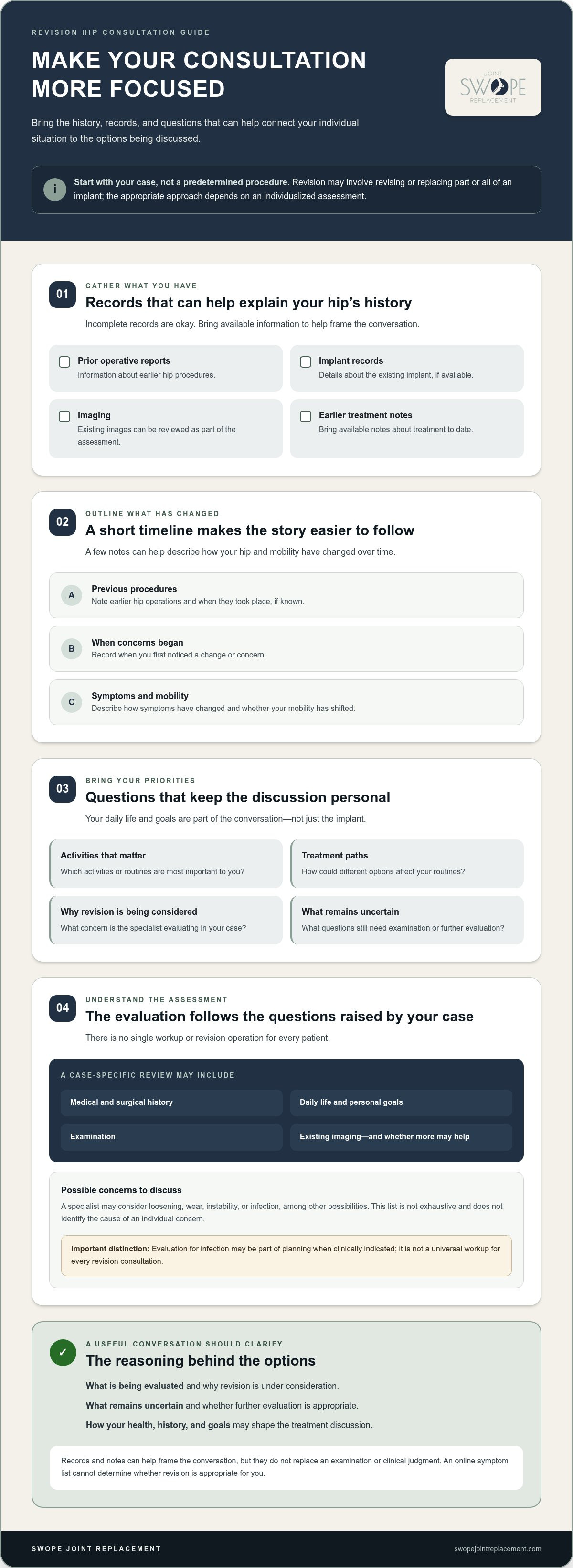
A revision plan begins with a conversation, not a predetermined procedure. The specialist reviews your medical and surgical history, what has changed, how your hip affects daily life, and what you hope to do. Available records and clinical information help shape the discussion, but they do not replace an examination or clinical judgment.
Examination and imaging choices depend on the questions raised by your case. A clinician may review existing imaging and decide whether additional studies could help assess the implant or guide next steps. There is no single imaging sequence for every patient. If infection is a concern, evaluating for it may be part of planning when clinically indicated, rather than a universal workup for every revision consultation.
A useful plan should make the reasoning clear: what the clinician is evaluating, what remains uncertain, and how the findings may affect treatment options. The goal is an informed discussion tailored to your circumstances, not a conclusion based on a symptom list or a statistic alone.
What records and information can help prepare for a consultation?
Bring what you have, even if your records are incomplete. Prior operative reports, implant records, imaging, and notes about earlier treatment may help the specialist understand your hip’s history. A short timeline can make the conversation easier: note prior procedures, when concerns began, how symptoms have changed, and whether your mobility has shifted.
Write down your priorities and questions, too. You might want to discuss which activities matter most or how different treatment paths could affect your routines. These notes help keep the consultation focused on what you need to understand.
How the suspected reason for revision shapes planning
Different concerns can lead to different clinical questions. A specialist may consider loosening, wear, instability, or infection, among other possibilities. This list is not exhaustive and cannot identify the cause of your concern. Examination and available records help determine what should be explored and whether further evaluation is appropriate.
This distinction matters because a plan should respond to the suspected problem rather than assume every implant concern calls for the same procedure. Broader context on individualized revision care is available in this guide to complex joint revision.
Research can provide useful background, but a published finding does not predict an individual patient’s experience. When reviewing statistics in educational material, consider whether the research applies to the patient and question at hand. A specialist can help put evidence into context without treating a group result as a personal forecast.
Swope Joint Replacement’s revision hip care provides a physician-led, personalized setting to discuss your case directly with the physician.
How to compare revision hip replacement specialists in Kansas City
When comparing care, consider how a recommendation is reached, how your questions are handled, and what practical arrangements are involved. A specialist’s explanations should help you understand the reasoning behind a proposed plan, including what is known, what remains uncertain, and whether alternatives are appropriate to discuss. These factors can support a considered decision, but they cannot guarantee a particular surgical outcome.
Use the comparison below as a framework, not a scorecard. The right priorities depend on your case and what matters to you.
Which clinical and communication factors matter most?
Revision experience matters because an existing implant and its history shape the clinical questions and options. Consider whether the specialist can explain what makes your case distinct, why a recommendation is being made, and what uncertainties remain. A useful conversation includes potential risks and alternatives, where appropriate, rather than presenting surgery as the only possible answer.
You should also have an opportunity to share your goals directly with the physician. Information about Kansas City joint revision considerations can help you think through questions to raise.
How care access and financial terms affect your decision
Care arrangements shape the experience around clinical decisions. Consider how the practice describes physician access, coordination, and follow-up so you understand how your questions fit into care. At Swope Joint Replacement, direct physician access is part of a concierge model designed for personalized, unhurried discussion.
Financial details deserve the same clarity. Swope operates outside in-network insurance arrangements and offers cash pricing and out-of-network options. Out-of-network benefits vary by plan, and reimbursement is not guaranteed; your plan’s terms determine coverage and your potential responsibility. Understanding those terms alongside the clinical discussion can help you assess whether the care model fits your needs.
Swope Joint Replacement’s revision hip care is a local option for personalized, physician-led discussion in the Kansas City area.
What to prepare before a Kansas City revision hip consultation
Some preparation can help you use consultation time well. You do not need a perfect file or a medical explanation for every change. Bring what you have, describe what you have noticed, and be ready to share what you hope to understand. Records can support the discussion, but they do not replace an examination or the specialist’s clinical judgment.
Use this sequence to organize your visit:
Gather available records. Collect prior operative reports, implant information, imaging, and notes about earlier treatment. If some items are missing, do not let that stop you from preparing.
Write a brief timeline. Note when concerns began, how they have changed, any previous procedures, and whether your mobility or daily routines have shifted.
List your concerns and goals. Include activities you want to return to or preserve, along with anything about treatment that worries you.
Prepare practical questions. Write down what you want to understand about the recommendation, follow-up, and financial arrangements.
If you’re traveling from Overland Park, Olathe, Lenexa, Lee’s Summit, Leawood, Blue Springs, or Independence, keeping records and questions together can make it easier to bring the details you want to discuss. The practice serves patients in these communities and Kansas City. A written list can also help if the conversation covers complex information. Take notes or bring someone you trust to help listen, if that would be useful.
Questions to bring about the proposed procedure and alternatives
Ask why revision is being considered in your case and what information supports the recommendation. You may also ask which alternatives could be appropriate, what individualized risks are relevant, and what recovery planning and follow-up might involve. Before making a decision, explain the plan in your own words and invite clarification about anything that remains unclear.
Planning for insurance and cash-pay conversations
Swope Joint Replacement offers cash pricing and out-of-network insurance options, not in-network billing. Review your plan documents and ask your insurer about your individual benefits, coverage terms, and potential patient responsibility. Benefits vary by plan, and reimbursement is not guaranteed. Keep notes on what your insurer tells you so you can compare that information with the practice’s financial details.
Financial questions are a reasonable part of planning care. Ask what the cash-pricing arrangement includes and what costs may be separate, then consider those details alongside the clinical recommendation and your priorities. General online estimates cannot predict your own costs or insurance response. Your plan documents and discussions about your specific benefits are more relevant to your situation.
Preparing does not mean you need to decide before the appointment. It gives you a clearer starting point and helps keep the conversation centered on your case. Learn about revision hip care at Swope Joint Replacement.
Revision hip replacement care with Swope Joint Replacement in Kansas City
Considering another operation can feel like a significant decision, especially when you are still trying to understand what has changed with a previous implant. Swope Joint Replacement provides revision hip replacement and personalized orthopaedic care in the Kansas City area. The concierge model centers on direct physician access and unhurried discussion, giving you the opportunity to talk through your history, concerns, and priorities with the physician.
A consultation is a chance to understand the clinical reasoning behind possible next steps. Revision is not automatically the answer for every implant concern. The discussion can clarify what is known about your case, what questions may need further evaluation, and which options are appropriate to consider based on your individual needs.
What patients can expect from Swope’s care model
With direct physician access, you can discuss your revision case with the physician. The concierge approach emphasizes personalized care and time for questions. This can help you understand how your medical history, current concerns, and personal goals relate to a recommendation.
Revision options are considered in relation to the individual patient, not as a fixed approach for every implant problem. Ask why a particular option is being considered, what alternatives may be relevant, and what remains uncertain. The goal is a clearer understanding of the decision in front of you, without assuming a specific treatment or outcome.
Taking the next step toward a revision consultation
If you’re in Kansas City or nearby Overland Park, Olathe, Lenexa, Leawood, Lee’s Summit, Blue Springs, or Independence, a consultation is an opportunity to discuss your concerns and possible next steps. Bring available records, such as prior operative reports or imaging, along with a short timeline of changes and a list of questions. Missing records should not prevent you from explaining what you have experienced.
Share what has changed and how it affects your daily activities.
Describe the goals that matter most to you.
Ask what information supports the recommendation and what alternatives may be appropriate.
Make note of questions you still have about planning or follow-up.
Financial arrangements are also part of an informed conversation. Swope Joint Replacement offers cash pricing and out-of-network insurance options; the practice does not participate in in-network insurance arrangements. Plan benefits and patient responsibility vary, so review your insurance documents and speak with your insurer about your specific coverage. No general estimate can determine your individual benefits or reimbursement.
You do not need to arrive with a decision already made. Review Swope Joint Replacement’s revision hip care to learn about discussing your history, goals, and questions in a personalized setting.
Take the next step at your own pace
You do not have to resolve every question before speaking with a specialist. A consultation can help you understand what needs attention, discuss choices that may fit your situation, and decide what information you still need. You remain an active part of the conversation, with room to consider the recommendation and how it aligns with your priorities.
If you’re looking for a revision hip replacement specialist Kansas City patients can consult, Swope Joint Replacement provides revision hip care through a personalized, physician-led model. You can discuss your case directly with the physician, with transparent cash pricing and out-of-network options as part of the care model.
Schedule a consultation with Swope Joint Replacement to discuss your questions and possible next steps.
Frequently Asked Questions
Is revision hip replacement more complex than primary hip replacement?
Revision surgery can involve additional considerations because the hip already has an implant and a surgical history, but the level of complexity varies from case to case. The surgeon may need to assess the existing components and understand why further treatment is being considered. Ask which parts of your situation affect planning and what factors could change the proposed procedure. A revision does not require the same approach for every patient.
Can a second opinion help me decide whether I need revision hip surgery?
Yes. A second opinion can help you understand the reasoning behind a recommendation, review other possible approaches, and identify questions that remain unresolved. Bring the original assessment and relevant records so the consulting specialist can understand what has already been considered. If the opinions differ, ask each clinician to explain the evidence and uncertainties behind their view. A second opinion informs your decision, but does not guarantee that surgery will or will not be recommended.
What records should I bring to a revision hip replacement consultation?
Bring prior hip surgery reports, an implant identification card or records, imaging reports, and copies of images if available. A list of medications, allergies, and other relevant health conditions can also help the clinician understand your medical context. If you are unsure how to obtain a record, contact the office or facility that created it. Do not delay a consultation simply because you cannot gather every document beforehand.
How long does recovery take after revision hip replacement?
Recovery varies, so there is no timeline that applies to every revision. The procedure performed, your health, and your circumstances can affect activity progression and support needs. Ask the surgeon which milestones are realistic for your case, what restrictions may apply, and how follow-up will guide adjustments. Before surgery, consider practical needs such as transportation, help at home, and time away from work, based on the plan discussed with your care team.
Does insurance cover revision hip replacement with an out-of-network surgeon?
Coverage depends on the terms of your individual plan, and out-of-network benefits do not guarantee reimbursement. Swope Joint Replacement operates outside in-network insurance arrangements and offers out-of-network options and cash pricing. Before making financial decisions, ask your insurer how your plan handles out-of-network surgeon services, deductibles, coinsurance, and any required approvals. Request details about patient responsibility from the relevant parties; another patient’s coverage may not apply to you.
What happens if an evaluation does not recommend revision surgery?
If revision is not recommended, ask what the evaluation suggests about your concern and what the next step may be. Depending on your individual findings, the discussion could include continued observation, non-operative care, or further evaluation if clinically appropriate. You can also ask what changes should prompt another discussion and when follow-up makes sense. A recommendation against surgery at that time does not dismiss your concerns; it clarifies the current plan for your case.



Comments