Unhurried Orthopedic Consultation in Kansas City: What to Expect

An orthopedic visit should leave you with more clarity, not more unanswered questions. If you’re seeking an unhurried orthopedic consultation kansas city, it’s reasonable to want time to explain what’s bothering you, understand the evaluation, and speak directly with the physician making recommendations. Feeling rushed or unsure about what comes next can make an already difficult decision feel harder.
A thoughtful consultation puts understanding before decisions. At Swope Joint Replacement, direct physician involvement and individualized attention support a focused conversation about your symptoms, relevant history, and evaluation. You can discuss what the findings may mean, ask questions, and consider appropriate options, including non-operative care and surgical treatment when relevant.
This article explains what to expect, from preparing for your visit to discussing possible next steps. You’ll also learn how to make space for your questions and share the activities and priorities that matter to you. The goal is a considered plan that reflects your circumstances, so you can move forward with a clearer understanding and at your own pace.
Table of Contents
What an unhurried orthopedic consultation in Kansas City should help you understand
You deserve time to explain what hurts, when it began, and how it affects your daily life. You also deserve a clear conversation about what the evaluation suggests and which choices may be appropriate. If past appointments have left you feeling unheard or uncertain, it’s reasonable to want a more focused experience.
An unhurried orthopedic consultation is a focused evaluation and conversation that helps you understand your concern, consider appropriate options, and discuss reasonable next steps, without promising a set visit length or a particular diagnosis. The aim is clarity, not pressure to choose a treatment before you understand it. An orthopedic concern may involve a joint, bone, or another part of the musculoskeletal system; Orthopedic surgery describes the broader field. A consultation can help clarify what applies to your situation.
That distinction matters if you’re looking for an unhurried orthopedic consultation kansas city. The value is not measured by a guaranteed number of minutes. It comes from having space to describe your concern, hear the physician’s assessment, and understand why a particular next step is being considered. Evaluation and recommendations depend on your symptoms, relevant information, and the physician’s clinical judgment.
How a planned orthopedic evaluation differs from urgent care
A planned consultation is suited to a focused discussion of an ongoing concern, such as joint discomfort or a limitation that affects everyday activities. An acute injury may call for prompt assessment based on its severity and circumstances. These are different needs: one centers on a considered conversation, while the other centers on immediate evaluation. The appropriate setting depends on your situation and how urgently you need care.
What patients need from the conversation
Your account helps put the clinical evaluation in context. Describe where you feel symptoms, what tends to bring them on, and which activities have become difficult. You don’t need a diagnosis or medical terminology. Everyday details, such as trouble walking comfortably or completing a usual task, help explain what matters to you.
Your priorities belong in the discussion, too. You might want to understand non-operative approaches, ask what an evaluation can clarify, or talk through how treatment choices could affect your routine. Questions are part of making an informed decision. A concierge approach with direct physician access supports that exchange and keeps the discussion centered on your concerns. For more context on this model, the concierge orthopaedic surgeon guide explains what direct, individualized care can mean for patients.
By the end of a useful visit, you should have a clearer understanding of what has been evaluated, which options may fit your circumstances, and what next steps are reasonable. You can leave with questions answered, or with a clear sense of what still needs discussion. The goal is a considered plan, not a rushed decision.
What happens during a thorough orthopedic consultation
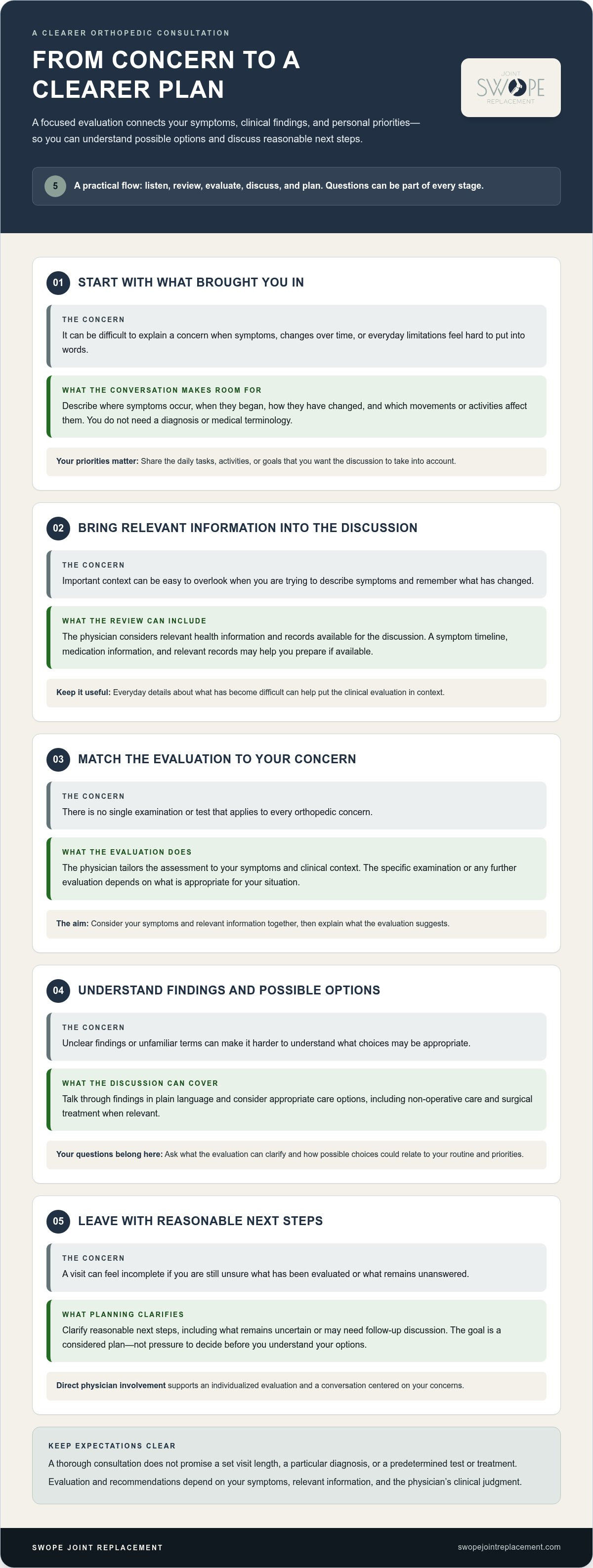
A thorough evaluation has a clear purpose, though the steps depend on your concern. During an unhurried orthopedic consultation kansas city, the physician can listen to your concerns, review relevant information, assess what’s appropriate, discuss options, and clarify next steps. Questions can be part of every stage, not just saved for the end.
A thorough orthopedic evaluation connects your symptoms, clinical findings, and personal priorities so you can understand possible options and make an informed decision about what comes next. It doesn’t require a predetermined test or treatment. Your physician uses clinical judgment to guide the assessment based on what you share and what the evaluation shows.
Listen: You describe what brings you in, how the concern has changed, and what you hope to understand.
Review: The physician considers relevant health information and records available for the discussion.
Evaluate: The assessment is tailored to your concern. The specific examination or any further evaluation depends on the clinical context.
Discuss: You talk through the findings in plain language and consider appropriate care options.
Plan: You clarify reasonable next steps, including what remains uncertain or may need follow-up discussion.
Starting with your symptoms and daily priorities
Begin with what you’ve noticed. Describe where symptoms occur, when they started, whether they have changed, and which movements or activities affect them. It can also help to explain practical limitations, such as difficulty with a routine task or a favorite activity. These details give the physician useful context without requiring you to identify the cause yourself.
Your goals help shape the conversation, too. You may want to stay active, understand why a joint is bothering you, or explore whether non-operative care could be appropriate. The physician guides the evaluation according to your concern, while your questions and priorities help keep the discussion relevant to your life.
Discussing findings, options, and unanswered questions
After considering the information and evaluation, the physician can explain what the findings may mean and how they relate to your concern. Ask for unfamiliar terms to be explained in everyday language. If you’re weighing different paths, ask what each option is intended to address, what the next step involves, and what questions remain. The goal is understanding, not pressure to decide before you’re ready.
Depending on the clinical situation, treatment discussions may include non-operative approaches as well as surgical considerations. There isn’t one plan that fits every person; appropriate options depend on your evaluation and circumstances. Direct conversation with the physician makes it easier to clarify recommendations as they arise. Learn more about how direct physician access in orthopedics supports patient understanding.
Swope Joint Replacement’s concierge orthopaedic care offers a setting for individualized discussion with the physician.
A Kansas City consultation case study: from concern to a clearer plan
Representative consultation walkthrough, not a patient testimonial: This general example shows how a planned consultation may unfold. It does not describe a specific patient, diagnosis, test, treatment choice, or result. The actual evaluation and next steps depend on the individual concern and the physician’s clinical judgment.
The purpose of this walkthrough is to show how a focused conversation can help organize an orthopedic concern. A patient arrives with a question about a problem. The starting point is not an assumed diagnosis or treatment plan, but an opportunity to explain what prompted the visit and what they hope to understand.
The patient's initial concern and questions
In a typical consultation, the patient may describe what they’ve noticed, how it has changed, and whether it affects everyday activities. The physician may ask follow-up questions about the history and the patient’s priorities. A patient might want to understand what could be contributing to the problem, what the evaluation can clarify, or how different care paths could fit their goals.
There’s no need to arrive with a firm explanation. Useful observations include what feels different, when the concern is most noticeable, and what the patient wants to get back to doing or continue doing. Those details make the conversation specific without turning an individual’s experience into a diagnosis before the evaluation.
How the discussion shapes possible next steps
The physician guides the assessment based on the concern and the information available. Depending on the situation, the discussion may include relevant findings, whether further evaluation is appropriate, and which treatment options merit consideration. Imaging, a particular examination, or a specific treatment is not part of every consultation.
If options are discussed, the patient can ask what each is intended to address and how it relates to their priorities. Non-operative care may be part of the conversation when clinically appropriate; surgical questions may also be discussed when relevant. The physician explains recommendations, while the patient’s questions and preferences help inform a considered decision. This general example does not establish which choice is right for another person.
A reasonable next step might involve proceeding with an option discussed, gathering additional information, or continuing the conversation. The appropriate step depends on the individual evaluation. The important point is that the patient understands what is being proposed and why, as well as what remains uncertain. A clearer plan is not a promise of a particular clinical result. It is a shared understanding of the decision in front of the patient.
For someone seeking an unhurried orthopedic consultation kansas city, this walkthrough offers a practical picture of the process without presenting an invented story as fact. A thoughtful visit makes room for the patient’s account, the physician’s assessment, and a discussion of options before next steps are considered.
How to prepare for an unhurried orthopedic appointment in Kansas City
A little preparation can help you use the conversation well, but you don’t need to arrive with a diagnosis or a perfect account of every symptom. Bring what you have, note what you’ve noticed, and consider what you most want to understand. The goal is to give the physician useful context and make it easier to ask the questions that matter.
Records and details that can make the discussion clearer
If available, gather relevant imaging reports, prior visit notes, and information about treatments you’ve tried. Bring an up-to-date medication list or write down medication names and doses. If records are missing, don’t let that stop you from explaining your concern. The physician will guide an evaluation based on your situation and the information available.
A short written timeline can be useful. Note when you first noticed the problem, how it has changed, and what seems to affect it. Include activities that have become difficult, such as walking a usual distance, using stairs, or completing a routine task, if those examples fit your experience. Note what you hope to keep doing or return to. These details connect the clinical discussion to your everyday priorities.
Relevant prior imaging reports and visit notes, if available
Medication information and a brief history of treatments tried
A symptom timeline, including changes and activities affected
Your main questions and personal priorities for care
Questions to bring to the appointment
Writing questions down can make it easier to raise them during the visit. You might ask what the evaluation suggests, what remains uncertain, and whether further assessment is appropriate. If treatment options come up, ask which non-operative or surgical approaches may be relevant to your circumstances and what each is intended to address. You can also ask what follow-up might involve and what decisions, if any, need to be made now.
Financial questions belong in the conversation, too. If you’re considering out-of-network care or cash pricing, ask how the practice’s financial arrangements relate to your situation and what information you need before proceeding. Swope Joint Replacement operates outside in-network insurance arrangements and offers cash pricing and out-of-network options. The out-of-network benefits patient guide can help you prepare for questions about benefits and payment.
For an unhurried orthopedic consultation kansas city, a concise list is enough. Bring notes on your phone or on paper, and ask the physician to explain unfamiliar terms in plain language. You don’t have to cover every question at once. Start with what feels most important, then work through the rest as the discussion allows.
Ready to discuss your orthopedic concerns with direct physician involvement? Explore Swope Joint Replacement’s consultation approach.
Swope Joint Replacement's unhurried orthopedic consultation in Kansas City
An orthopedic concern can raise several questions. You may want to understand what is causing a limitation, whether non-operative care is appropriate, or what a surgical option could involve. Swope Joint Replacement’s concierge model centers the evaluation on your concern, with direct physician access and individualized attention to support a clear, focused discussion.
The purpose of an unhurried orthopedic consultation kansas city is not to steer every patient toward surgery. It’s to help you understand the evaluation, discuss options relevant to your situation, and consider reasonable next steps. The physician’s recommendations depend on your concern and clinical assessment. Your questions and personal priorities are part of that conversation.
Direct physician access and individualized attention
Direct physician involvement means you can discuss your concern with the physician guiding the evaluation. Describe what has changed, explain how it affects everyday life, and raise questions as they come up. The physician can explain the assessment and recommendations in terms that relate to your situation. This approach prioritizes careful listening and clear communication, without promising a particular appointment length or clinical result.
Your preferences matter, too. If maintaining a certain activity is important, or you want to understand non-operative approaches before considering surgery, say so. Those priorities give context to the discussion. The goal is to help you understand which options may be appropriate and why, not to rush you toward a decision.
A clear next step for Kansas City-area patients
Swope Joint Replacement provides individualized orthopaedic evaluations for joint concerns and general orthopaedic care, as well as non-operative treatment and fracture care. If surgery is relevant to your concern, it can be part of the discussion, but it is not assumed to be the right choice for everyone. The evaluation guides which options are appropriate for your circumstances.
It’s also useful to understand the financial arrangement before moving forward. Swope Joint Replacement operates outside in-network insurance arrangements and offers cash pricing and out-of-network options. These details are part of making an informed decision about care, alongside the clinical discussion. You can raise questions about the financial arrangement and what it means for your situation.
Swope Joint Replacement serves patients in Overland Park, Kansas City, Olathe, Lee’s Summit, Lenexa, Leawood, Blue Springs, and Independence. If you’re looking for a more personal conversation about an orthopedic concern, take the next step at your own pace. Explore a more personal orthopaedic consultation.
Take your next step with confidence
You don’t have to make every decision before you understand the choices. A useful next step can simply be getting a clearer view of what’s going on, what remains uncertain, and what matters most to you. That perspective can help you approach an unhurried orthopedic consultation kansas city with a steadier sense of what you want from the conversation.
Consider what would help you feel informed: a plain-language explanation, time to weigh options, or a plan that takes your daily life into account. You’re entitled to ask questions and consider recommendations. Your priorities are not separate from the discussion; they help give it direction.
If you’re ready to explore care centered on a direct conversation about your orthopedic concerns, explore a more personal orthopaedic consultation with Swope Joint Replacement. Start with your questions and take the process one considered step at a time.
Frequently Asked Questions
Is an unhurried orthopedic consultation the same as a concierge consultation?
No. “Unhurried” describes the feel and focus of a conversation, while “concierge” describes a care model that can include direct access to the physician. The ideas can overlap, but they aren’t interchangeable. Before choosing a consultation, understand who will evaluate you, how the visit is structured, and what payment arrangement applies. Those details can help you decide whether the experience fits your needs.
What happens during an orthopedic consultation?
The physician discusses your concern and relevant health history, evaluates the issue, and explains appropriate next steps. The assessment varies with your symptoms and clinical needs. Give practical context, such as which movements make a concern more noticeable or what activities you’ve changed because of it. Ask the physician to clarify unfamiliar terms or explain what remains uncertain. A consultation supports an informed choice; it doesn’t commit you to surgery.
Can I bring someone with me to an orthopedic appointment?
Patients often appreciate having a trusted person listen, take notes, or help remember questions. If you’d like someone to join you, discuss visitor arrangements when scheduling. You can also decide beforehand how that person can support you, such as listening quietly or reminding you of a question. Your concerns and preferences should remain central, and you can direct questions to the physician throughout the conversation.
How should I prepare for an orthopedic consultation?
Write down your main concern, when you first noticed it, and one or two examples of how it affects your routine. Bring medication information and relevant records or imaging reports if available. A short list of questions can help, such as “What does this finding mean?” or “What should I watch for before follow-up?” You don’t need to identify the cause yourself. Your physician’s role is to assess the concern and discuss appropriate care.
Does an orthopedic consultation mean I will need surgery?
No. An orthopedic consultation is an evaluation and discussion, not a commitment to an operation. Based on the clinical assessment, the physician may discuss non-operative care, surgical considerations, or other appropriate next steps. Ask why a particular option is being considered and what alternatives may fit your situation. The right approach depends on your needs and findings, so don’t assume surgery is necessary before the conversation.
Does Swope Joint Replacement accept in-network insurance?
No. Coverage and reimbursement depend on the details of your own plan, so review those terms as you consider care. The practice serves patients in Kansas City and nearby communities, including Overland Park, Olathe, Lee’s Summit, Lenexa, Leawood, Blue Springs, and Independence. Understanding the payment arrangement can help you make a more informed decision.
Comments